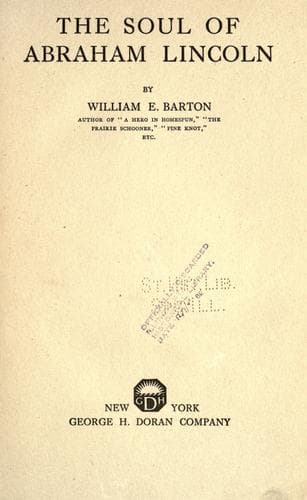
The Soul of Abraham LincolnBarton, William E. (William Eleazar)
Religion
The Soul of Abraham Lincoln
Barton, William E. (William Eleazar)
Lincoln, Abraham, 1809-1865 -- Religion; Presidents -- United States -- Biography
I have looked through many Lives of Lincoln to discover whether any
biographer of Lincoln had ever looked up this book, and thus far have
not discovered any. I have inquired for the book at the Chicago
Historical Library and the Illinois Historical Library, and neither of
those libraries contains it, nor had it been thought of in connection
with Lincoln. Mr. Oldroyd does not have it in his matchless collection,
where I hoped I might find the veritable copy that Lincoln read, and
he had never heard of it; nor does the matron of the Lincoln Home at
Springfield know anything about it.[43]
I shall give in the Appendix of this book an outline of the contents of
Dr. Smith's solid work, that the reader may judge for himself whether
such a book, placed in the hands of Mr. Lincoln at such a time, may not
have had upon his mind all the influence that Dr. Smith ever claimed
for it.
CHAPTER XIV
"VESTIGES OF CREATION"
LINCOLN was a man of few books. Much has been made of the fact that
when a lad he eagerly read every book within reach; but he did not
continue that habit in his mature years. Something happened to the
lad in adolescence that changed him mentally as well as physically.
His sudden upshoot in stature permanently tired him; he became
disinclined to activity. His movements were much slower, and his
habits of thought more sluggish. Arnold attempts to make a list of his
"favorite books," but does not make much progress (_Life of Lincoln_,
pp. 443, 444). About all there is to be said is that he read the
Bible both as a boy and man, and came to have an appreciation and
love of Shakspeare, particularly _Hamlet_ and _Macbeth_, but he never
read Shakspeare through. He was fond of some of the poems of Burns,
the rollicking humor of "Tam o' Shanter," the withering scorn--an
element which had a considerable place in Lincoln's nature--of "Holy
Willie's Prayer," the manly democracy of "A Man's a Man for a' That";
but he never quoted Burns. He had little appreciation of music, but
liked negro melodies--not the genuine ones, but the minstrel-show
sort--camp-meeting ballads, Scotch songs, and mournful narrative
compositions, of which the woods were moderately full in his boyhood,
and which he continued to enjoy. Broadly humorous songs moved him to
mirth, but he cared more for those that were sad. Everyone knows his
love for the mediocre but melodious poem, "O Why Should the Spirit
of Mortal be Proud," which like the religious song he loved, "How
tedious and tasteless the hours," moved mournfully in triple time,
flaunting crêpe in the face of the spirit of the waltz. About the only
contemporary poem which he is known to have cared much for was Holmes'
"Last Leaf," in which he was particularly moved by the lines,--
"_The mossy marbles rest
On the lips that he has prest,
In their bloom,
And the names he loved to hear
Have been carved for many a year
On the tomb._"
Public-domain text, read in full here on John Shaqi.
Reviews
Reviews
No reviews yet
Be the first to share your thoughts on this work.
Elsewhere in the archive
Join the Discussion
Join the discussion
Sign in to leave a comment or review.
Sign InorCreate an account