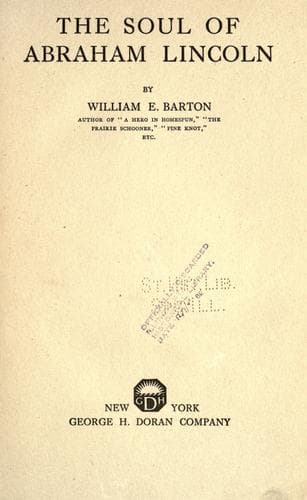
The Soul of Abraham LincolnBarton, William E. (William Eleazar)
Religion
The Soul of Abraham Lincoln
Barton, William E. (William Eleazar)
Lincoln, Abraham, 1809-1865 -- Religion; Presidents -- United States -- Biography
Herndon is correct in saying that Lincoln read less and thought more
than any man prominent in public life in his generation.
But the few books that Lincoln read in his mature years affected him
greatly; and when we know of his reading a book because he cared for
it, we may well endeavor to discover that book and inquire whether it
be not possible to trace its influence in the development, slow but
sure, of the mental and spiritual processes of Abraham Lincoln.
A highly important statement concerning the philosophical and religious
views of Lincoln is found in Herndon's _Life of Lincoln_, and it is
remarkable that neither Herndon nor any of the hundreds of writers
who have gleaned, as all must glean, from his pages, appears to have
followed further the most important of its suggestions:
"For many years I subscribed for and kept on our office table the
_Westminster_ and _Edinburgh Review_ and a number of other English
periodicals. Besides them, I purchased the works of Spencer, Darwin,
and the utterances of other English scientists, all of which I
devoured with great relish. I endeavored, but with little success,
in inducing Lincoln to read them. Occasionally he would snatch one
up and peruse it for a little while, but he soon threw it down with
the suggestion that it was entirely too heavy for an ordinary mind to
digest. A gentleman in Springfield gave him a book called, I believe,
_Vestiges of Creation_, which interested him so much that he read
it through. The volume was published in Edinburgh, and undertook to
demonstrate the doctrine of development, or evolution. The treatise
interested him greatly, and he was deeply impressed with the notion
of the so-called 'universal law' evolution; he did not extend greatly
his researches, but by continual thinking in a single channel seemed
to grow into a warm advocate of the new doctrine. Beyond what I have
stated he made no further advances into the realm of philosophy.
'There are no accidents,' he said one day, 'in my philosophy. Every
effect must have its cause. The past is the cause of the present,
and the present will be the cause of the future. All these are
links in the endless chain stretching from the Infinite to the
finite.'"--HERNDON, III, 438.
I count it remarkable that neither Herndon nor any other of Lincoln's
biographers appears to have made further inquiry about this book,
which is not mentioned in Herndon's index, and which I have not found
referred to elsewhere in connection with Lincoln. The book is not in
any of the great Lincoln collections which I have visited, nor has any
Lincoln student to whom I have mentioned it had it in mind, or failed
to be impressed with the value of it when we have discussed the matter.
Public-domain text, read in full here on John Shaqi.
Reviews
Reviews
No reviews yet
Be the first to share your thoughts on this work.
Elsewhere in the archive
Join the Discussion
Join the discussion
Sign in to leave a comment or review.
Sign InorCreate an account