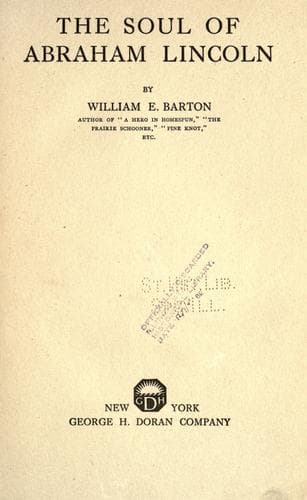
The Soul of Abraham LincolnBarton, William E. (William Eleazar)
Religion
The Soul of Abraham Lincoln
Barton, William E. (William Eleazar)
Lincoln, Abraham, 1809-1865 -- Religion; Presidents -- United States -- Biography
The book itself is not in the Lincoln Home at Springfield, nor is it
in the Oldroyd Collection at Washington, in one of which places I
hoped that it might be found. Neither the librarian of the Illinois
Historical Society in Springfield, nor Mr. Barker, the painstaking and
discriminating collector and vendor of Lincoln books in Springfield,
had ever noticed the title in Herndon's book, though both were at once
impressed with its significance when I called it to their attention.
The material in Herndon's lectures on Lincoln is pretty well absorbed
in his book, and quoted in this volume; but there are some interesting
additional details in Herndon's letters. In these, answering specific
questions or replying to definite statements, he now and then added
a statement which was not later included in his book, but which has
present interest and in some cases value.
The following is an excerpt from a letter of Herndon to John E.
Remsburg, and bears in an important way on Lincoln's use of _Vestiges
of Creation_:
"I had an excellent private library, probably the best in the city
for admired books. To this library Mr. Lincoln had, as a matter of
course, full and free access at all times. I purchased such books
as Locke, Kant, Fichte, Lewes; Sir William Hamilton's _Discussions
of Philosophy_; Spencer's _First Principles_, _Social Studies_,
etc.; Buckle's _History of Civilization_, and Lecky's _History of
Rationalism_. I also possessed the works of Parker, Paine, Emerson and
Strauss; Gregg's _Creed of Christendom_, McNaught on _Inspiration_,
Volney's _Ruins_, Feuerbach's _Essence of Christianity_, and other
works on Infidelity. Mr. Lincoln read some of these works. About the
year 1843[44] he borrowed the _Vestiges of Creation_ of Mr. James
W. Keys, of this city, and read it carefully. He subsequently read
the sixth edition of this work, which I loaned him. He adopted the
progressive and development theory as taught more or less directly in
that work. He despised speculation, especially in the metaphysical
world. He was purely a practical man."--REMSBURG: _Six Historic
Americans_, pp. 114-15.
As already stated Dr. Smith's book _The Christian's Defence_ is
excessively rare. The edition was small; the argument which it
contained was modified with the progress of discovery; there was little
to keep in circulation the few copies of the book that survived. They
have nearly all disappeared. I have searched the second-hand shops
of the principal cities and the dusty duplicates of libraries with
repeated disappointment. For this reason, I have carried a complete
analysis of the book into the Appendix of this volume; for few who read
the present volume will be able to see the book itself.
Public-domain text, read in full here on John Shaqi.
Reviews
Reviews
No reviews yet
Be the first to share your thoughts on this work.
Elsewhere in the archive
Join the Discussion
Join the discussion
Sign in to leave a comment or review.
Sign InorCreate an account