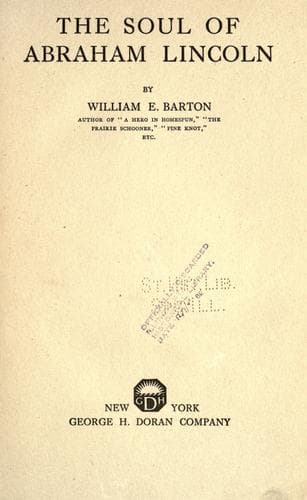
The Soul of Abraham LincolnBarton, William E. (William Eleazar)
Religion
The Soul of Abraham Lincoln
Barton, William E. (William Eleazar)
Lincoln, Abraham, 1809-1865 -- Religion; Presidents -- United States -- Biography
While superstition had its part in the life and thought of Lincoln, it
was not the most outstanding fact in his thinking or his character. For
the most part his thinking was rational and well ordered, but it had in
it many elements and some strange survivals--strange until we recognize
the many moods of the man and the various conditions of his life and
thought in which from time to time he lived.
_Was Lincoln a Quaker?_
In his autobiographical sketch written for Jesse W. Fell, Mr. Lincoln
stated that his paternal grandfather, Abraham Lincoln, emigrated from
Rockingham County, Virginia, to Kentucky about 1781 or 1782; "his
ancestors, who were Quakers, went to Virginia from Berks County,
Pennsylvania." This reference to a remote Quaker ancestry has suggested
to some writers the possibility that Mr. Lincoln himself may have been,
in conviction, a Quaker.
This suggestion is utilized to its full value and beyond by Henry Bryan
Binns, the first English biographer of Lincoln, whose book appeared in
1907, and others have followed his intimations. He says:
"In some brief autobiographical notes, Lincoln remarks that his
ancestors, when they left Berks County, Pennsylvania, were Quakers.
The allusion has significance, not merely because it is the only
reference to any religious body in these notes, but because it
suggests an interesting spiritual affiliation to which we shall refer
again later."
He fulfills this promise, and refers to it repeatedly. The Quaker
ancestry finds reinforcement in his assurance that the Shipley strain
in Nancy Hanks was "probably" Quaker. These references occur a number
of times in the early part of his book, and recur in the concluding
chapter with more than a suggestion that Mr. Lincoln continued to bear
some of the inherited spiritual qualities of the Quaker.
These suggestions lack evidential value. Lincoln's grandfather's
ancestors were believed by him to have been Quakers in Pennsylvania,
and their ancestors are believed to have been Puritans in
Massachusetts. But the New Englanders no more surely dropped their
Massachusetts Puritanism in Pennsylvania than the Pennsylvania
Quakers dropped their Quakerism in Virginia and Kentucky. The Quaker
ancestry was not forgotten nor was it a thing to be ashamed of,
but the distinctive tenets of the Friends had no large part in the
working creed of Abraham Lincoln. He respected the Quakers, and on
more than one occasion showed his interest in them; but there is no
reason to believe that he shared either their theology or their theory
of non-resistance. He was compelled to approve some severe measures
against American citizens who refused to fight, and a number of Quakers
suffered in consequence. Lincoln saw no way to prevent these sufferings
altogether, though he did his best to mitigate them, and he always
respected the principles of those who held in sincerity the Quaker
faith which he did not share.
_Was Lincoln a Unitarian or a Universalist?_
Public-domain text, read in full here on John Shaqi.
Reviews
Reviews
No reviews yet
Be the first to share your thoughts on this work.
Elsewhere in the archive
Join the Discussion
Join the discussion
Sign in to leave a comment or review.
Sign InorCreate an account