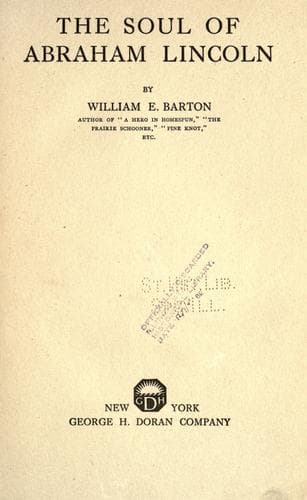
The Soul of Abraham LincolnBarton, William E. (William Eleazar)
Religion
The Soul of Abraham Lincoln
Barton, William E. (William Eleazar)
Lincoln, Abraham, 1809-1865 -- Religion; Presidents -- United States -- Biography
"'We have grown in numbers, wealth, and power as no other nation has
ever grown. But we have forgotten God. We have forgotten the gracious
hand which preserved us in peace, and multiplied and enriched and
strengthened us; and we have vainly imagined in the deceitfulness of
our hearts, that all these blessings were produced by some superior
wisdom and virtue of our own.'
"If this isn't _Calvinism_ pure and simple, then I don't know what
Calvinism is.
"Now, Mr. Editor, if you can show me any reference in _Mr. Lincoln's
own words_ that point as strongly toward 'Unitarianism' and those
truths which _it_ claims as peculiarly its own, I shall be glad to see
it.
"CHARLES B. TOLEMAN."
A number of Lincoln's old neighbors, contributing to the Irwin article
in denial of the alleged infidelity of Lincoln, affirm that he was a
Universalist. In their denial of his infidelity they were correct;
and also in their detection of the fallacy of Herndon in which he
counted every opinion to be infidel that did not conform to the severe
orthodoxy with which he was familiar. As between Herndon and these
writers, they were correct. Lincoln's "infidelity" consisted in good
part of his denial of eternal punishment. But that did not make him
an infidel; neither did it constitute him technically a Universalist.
The substratum of his belief was the old-time predestinarianism which
he heard in his youth and never outgrew. How he could make this blend
with his wide departures from conventional orthodoxy in other points,
those can best understand who have heard the kind of preaching on which
Lincoln grew up. Its effect is not easily obliterated.
_Was Abraham Lincoln a Methodist?_
This question would seem to require no answer, yet it is one that
should receive an answer, for claims have been made, and are still
current, which imply that Lincoln was actually converted in the
Methodist Church, whose doctrine he accepted because Calvinism
was repugnant to him; and that while he continued to attend the
Presbyterian Church, he was essentially a Methodist.
Lincoln had a very high regard for the Methodist Church. It was rent
asunder during the Civil War, and the Northern branch of the church
which had long been vigorously anti-slavery was warmly loyal. On May
18, 1864, in a letter of reply to a deputation of ministers from
that body, he said, "God bless the Methodist Church--bless all the
churches, and blessed be God who, in this our great trial, giveth us
the churches."
Public-domain text, read in full here on John Shaqi.
Reviews
Reviews
No reviews yet
Be the first to share your thoughts on this work.
Elsewhere in the archive
Join the Discussion
Join the discussion
Sign in to leave a comment or review.
Sign InorCreate an account