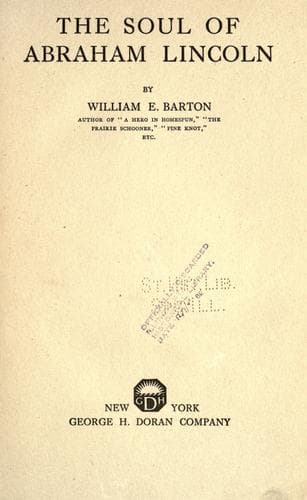
The Soul of Abraham LincolnBarton, William E. (William Eleazar)
Religion
The Soul of Abraham Lincoln
Barton, William E. (William Eleazar)
Lincoln, Abraham, 1809-1865 -- Religion; Presidents -- United States -- Biography
Already Bishop Fowler, to whom Colonel Jacquess alluded in his address
at Springfield as having no adequate account of Lincoln's conversion,
had accepted the story and incorporated it into the final version of
his famous lecture (_Patriotic Orations_, p. 102). The death of Colonel
Jacquess and the additions made by his brother give this incident its
permanent form in the _Christian Advocate_ article of November 11, 1909.
I am glad to have been able to obtain from the _Christian Advocate_
their last copy of that issue, outside their office file, and it
appears in full in the Appendix to this volume. It may be accepted as
the authoritative form of this story.
That the story as told by Colonel Jacquess must have had some element
of truth I think beyond question; that it occurred exactly as he
related it, I greatly doubt. The years between 1839 and 1897 numbered
fifty-eight, and that is more than ample time for a man's memory to
magnify and color incidents almost beyond recognition.
The story as it is thus told lacks confirmatory evidence.[53] If
Lincoln was converted in a Methodist Church in 1839 and remained
converted, a considerable number of events which occurred in subsequent
years might reasonably have been expected to have been otherwise than
they really were. Each reader must judge for himself in the light of
all that we know of Abraham Lincoln how much or how little of this
story is to be accepted as literal fact. The present writer cannot say
that he is convinced by the story.
_Was Abraham Lincoln a Freemason?_
In an address delivered before Harmony Lodge, in Washington, D. C.,
on January 28, 1914, Dr. L. D. Carman delivered an address, which has
since been printed, entitled "Abraham Lincoln, Freemason." In this
address it was set forth that "It was not an unusual practice in the
early days of Masonry in this country in sparsely settled localities,
remote from an active lodge, for several members of the fraternity to
get together, form an emergent or occasional lodge, and make Masons."
Abraham Lincoln was presumed to have been made such a Mason because of
utterances of his, quoted at length, which appeared to show familiarity
with Masonic usage.[54]
Those utterances, when examined, carry no such presumption, nor was
there any occasion for such an emergent lodge. A lodge existed at
Petersburg, near New Salem, and a number of Lincoln's friends belonged
to it; their names are on record. The records of the Springfield Lodge,
also, are preserved, and bear no mention of his name; nor is there any
evidence so far as the present author knows that on any occasion he
was ever in a Masonic Lodge. Orators may use the symbolic language of
architecture without knowledge of speculative Masonry, and Lincoln used
it so.
CHAPTER XXI
WHY DID LINCOLN NEVER JOIN THE CHURCH?
Public-domain text, read in full here on John Shaqi.
Reviews
Reviews
No reviews yet
Be the first to share your thoughts on this work.
Elsewhere in the archive
Join the Discussion
Join the discussion
Sign in to leave a comment or review.
Sign InorCreate an account