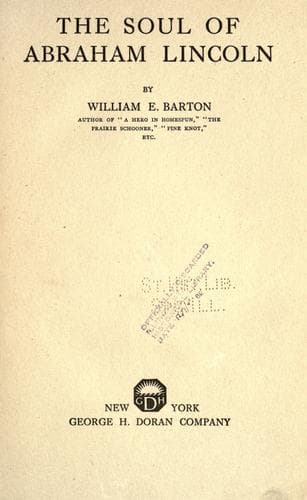
The Soul of Abraham LincolnBarton, William E. (William Eleazar)
Religion
The Soul of Abraham Lincoln
Barton, William E. (William Eleazar)
Lincoln, Abraham, 1809-1865 -- Religion; Presidents -- United States -- Biography
MR. THOMAS LEWIS, attorney in Springfield with an office on the same
floor and an elder in the First Presbyterian Church, informs us that
there was some real expectation that Lincoln would have united with
that church in Springfield after his views had been modified through
the influence of Dr. Smith. He says that Lincoln attended with
considerable regularity a series of revival meetings in progress in
the church, but was out of town when application was made for church
membership and the officers of the church were disappointed that he did
not then unite.
Rev. Dr. Phineas D. Gurley, of Washington, tells of conversations with
Lincoln concerning religion and of some expressed desires on the part
of Lincoln for church fellowship. His feeling of support in prayer was
manifest in his coming to the mid-week prayer service, where, however,
as Dr. Gurley affirms, he commonly sat in the pastor's room with an
open door, hearing the prayers that were offered but preferring not to
attract attention by his visible presence.
The best statement, and one that has been accepted as truly
representative of Lincoln's feeling with regard to church membership,
is one that comes to us on thoroughly good authority and from the
period immediately following Lincoln's death.
Hon. Henry C. Deming, member of Congress from Connecticut, in a
memorial address given before the Legislature of Connecticut, June 8,
1865, related that he had asked Mr. Lincoln why he never united with a
church, and Mr. Lincoln answered:
"I have never united myself to any church, because I have found
difficulty in giving my assent, without mental reservation, to the
long, complicated statements of Christian doctrine which characterize
their articles of belief and confessions of faith. When any church will
inscribe over its altars, as its sole qualification for membership, the
Saviour's condensed statement of the substance of both law and gospel,
'Thou shalt love the Lord thy God with all thy heart, and with all thy
soul, and with all thy mind, and thy neighbor as thyself,' that church
will I join with all my heart and all my soul" (p. 42).
To his Washington pastor, Rev. Phineas D. Gurley, he said that he could
not accept, perhaps, all the doctrines of his Confession of Faith,
"but," said he, "if all that I am asked to respond to is what our Lord
said were the two great commandments, to love the Lord thy God with all
thy heart and mind and soul and strength, and my neighbor as myself,
why, I aim to do that."
Public-domain text, read in full here on John Shaqi.
Reviews
Reviews
No reviews yet
Be the first to share your thoughts on this work.
Elsewhere in the archive
Join the Discussion
Join the discussion
Sign in to leave a comment or review.
Sign InorCreate an account