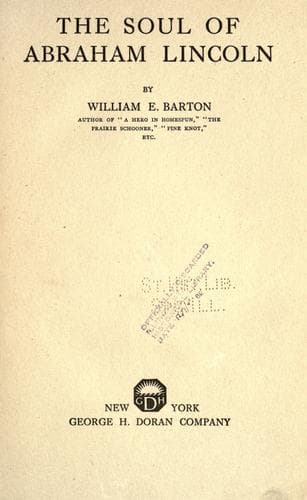
The Soul of Abraham LincolnBarton, William E. (William Eleazar)
Religion
The Soul of Abraham Lincoln
Barton, William E. (William Eleazar)
Lincoln, Abraham, 1809-1865 -- Religion; Presidents -- United States -- Biography
There are two interesting facts about this incident related by
Representative Deming. One is that Lincoln knew his Bible well enough
to challenge an unfamiliar passage and require that it be shown to him
before believing that the Bible contained it. Only a man who had read
his Bible much would have been so confident. The other is that this
story recalled to Mr. Deming that very important declaration of Lincoln
which is attested by a number of other credible witnesses in substance,
but which Deming first gave to the world in his notable address:
"I am here reminded of an impressive remark which he made to me
upon another occasion, and which I shall never forget. He said, he
had never united himself to any church, because he found difficulty
in giving his assent, without mental reservations, to the long
complicated statements of Christian doctrine which characterize their
Articles of Belief and Confessions of Faith. 'When any church,' he
continued, 'will inscribe over its altar as its sole qualification
for membership the Saviour's condensed statement of the substance
of both the law and Gospel, Thou shalt love the Lord thy God with
all thy heart, and with all thy soul, and with all thy mind, and thy
neighbor as thyself,--that church will I join with all my heart and
soul.'"--_Eulogy upon Abraham Lincoln, before the General Assembly of
Connecticut, 1865_, p. 42.
Henry C. Whitney knew Lincoln well, from the days of their circuit
riding in Illinois till Lincoln's death. His testimony is valuable:
"Mr. Lincoln was a fatalist: he believed, and often said, that
'_There's a divinity that shapes our ends,
Rough-hew them how we will,_'
and as a corollary from this belief, that the Almighty controlled the
affairs of men and made the wrath of men to praise Him. In all stages
of his administration and before, commencing with his first public
utterance after his election, he declared that with God's help he
should succeed, and without it he would fail. Likewise, before he was
run for the Presidency, he made frequent references to God in the same
spirit of devoutness and trust; and, therefore, he was honest; honest
with his Father on his dying bed, honest in what he feared was (and
which proved to be) his last affectionate farewell to his neighbors,
honest to the many eminent bands of clergymen and Christian people
who visited him, and honest with his Cabinet in the most important
consultation it ever held; then Lincoln, whether as man or as
President, believed in God as the Ruler of the Universe, in a blessed
hereafter, and in the efficacy of prayer. . . . Mr. Lincoln believed
himself to be an instrument of God; and that, as God willed, so would
the contest be. He also believed in prayer and its efficacy, and that
God willed the destruction of slavery through his instrumentality, and
he believed in the Church of God as an important auxiliary."--_Life on
the Circuit with Lincoln_, pp. 267-68.
Public-domain text, read in full here on John Shaqi.
Reviews
Reviews
No reviews yet
Be the first to share your thoughts on this work.
Elsewhere in the archive
Join the Discussion
Join the discussion
Sign in to leave a comment or review.
Sign InorCreate an account