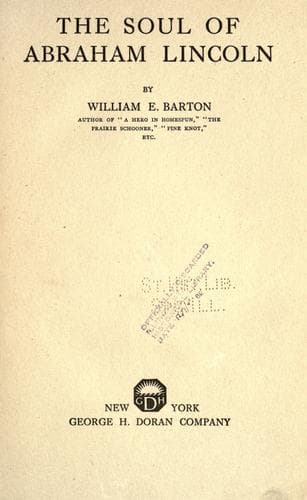
The Soul of Abraham LincolnBarton, William E. (William Eleazar)
Religion
The Soul of Abraham Lincoln
Barton, William E. (William Eleazar)
Lincoln, Abraham, 1809-1865 -- Religion; Presidents -- United States -- Biography
Among the men in Washington who best knew the mind of Abraham Lincoln
was Schuyler Colfax, Speaker of the House of Representatives, and
afterward Vice-President under General Grant. In his memorial address
delivered just after the assassination, he paid a high tribute to the
deep religious spirit of Lincoln as he knew it, and said:
"Nor should I forget to mention that the last Act of Congress signed
by him was one requiring that the motto, in which he sincerely
believed, 'In God we trust' should hereafter be inscribed upon all
our national coins."--HON. SCHUYLER COLFAX, in _Memorial Address in
Chicago, April 30, 1865_.
During his residence in the White House Mr. Lincoln again met the
discipline of personal bereavement. His son Willie died. There is
conflict of testimony as to Mr. Lincoln's love for his wife, though
the present writer believes that he truly loved her, but no one who
knew him ever doubted his devotion to his children. The death of this
little boy, William Wallace, who was born in Springfield, December 21,
1850, and died in the White House, February 20, 1862, seemed, according
to the testimony of Mrs. Lincoln, to turn his thoughts more to
religion. It must have recalled to him all that had occurred when his
other boy died in Springfield, and it brought new and solemn thoughts
and possibly convictions.
Moreover, he was now father to the boys of a nation. They were marching
at his order, singing,
"_We are coming, Father Abraham,
Six hundred thousand more._"
They were laying down their young lives for a cause that he told
them was holy. How he felt for the fathers and mothers of the land,
his letter to Mrs. Bixby and his countless deeds of mercy testify.
Again and again, as Ingersoll well said, he abused his great power
on the side of mercy and never otherwise. The deepening sense of
responsibility, as he affirmed, again and again drove him to his knees
(Noah Brooks in _Harper's Monthly_ for July, 1885). Did he consciously
change his theology? Very likely not; but he certainly became a more
and more deeply religious man under the discipline of these experiences.
Public-domain text, read in full here on John Shaqi.
Reviews
Reviews
No reviews yet
Be the first to share your thoughts on this work.
Elsewhere in the archive
Join the Discussion
Join the discussion
Sign in to leave a comment or review.
Sign InorCreate an account