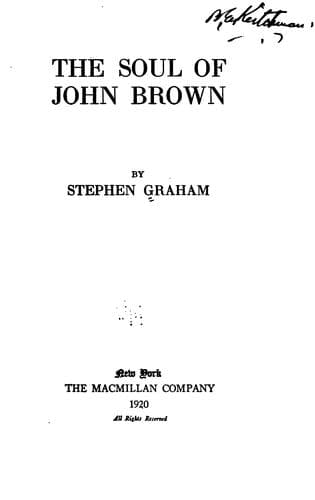
African Americans; United States -- Race relations
The South, they tell me, never alters. It is said to be the least
characteristic and most uninteresting part of the United States. “You
will not care for it,” I was told. “It has not changed in fifty years.”
It is certainly little visited. It does not exemplify the hustle and
efficiency of the North. And then you cannot lecture down there. It
is not a literary domain. The consequence is that in Great Britain
many people confound the “Southern States” with the Republics of South
America. I was asked in letters why I had gone South. It was thought
there must be less interest there. But that is a mistake. The South is
as vital as the West and the East. On the whole it is more picturesque.
It is not so diversified, but the vast areas of cotton on the one hand
and of sugar and corn and rice on the other, and the forests, present
well-marked features and give the South a handsome natural aspect. It
is true that the Southern point of view as regards the Negro does not
change very much, and that all vote one way, but it does not follow
that the Southern point of view as regards the whole future of the
United States has not been modified and will not change. The South has
been very poor and is becoming rich, will perhaps become very rich and
prosperous. It was almost deprived of political power, and now it has,
in an extraordinary way, regained political power. It is well known
that the opinion of a poor and ruined man changes when Fortune makes up
to him for the past. So also with the South.
Then, in considering a people as a whole, one is bound to reckon
character. Thus, in Great Britain, what important factors are the
ruggedness of Yorkshire and Lancashire, the caution of the Scots,
the authority-loving of the southern counties, the enthusiasm and
imaginativeness of the Celts. And in America one has to reckon, not
only with the Puritan fervor of New England, but with the determination
and turbulence and group instinct of the more cavalier spirit of the
South. Though heat makes the Southern women languid and the Southern
men fiery and quick of temper, it does not seem to make them weaker.
On the whole, the Southerner seems to have a stronger will than the
Northerner, and despite the exuberance of North and West, and a flood
of contrary ideas and sentiments, the Southerner remains, as it were,
eternally incapable of being suppressed. As long as America speaks, the
South will always speak. Therefore, the South is very significant in
American life.
Public-domain text, read in full here on John Shaqi.
Reviews
Reviews
No reviews yet
Be the first to share your thoughts on this work.
Join the Discussion
Join the discussion
Sign in to leave a comment or review.
Sign InorCreate an account