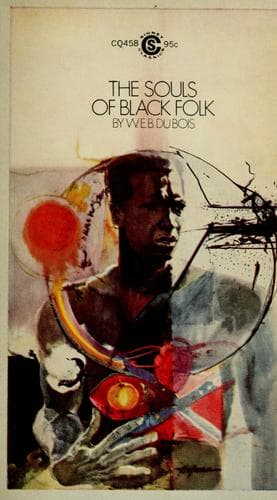
The Souls of Black FolkDu Bois, W. E. B. (William Edward Burghardt)
History
The Souls of Black Folk
Du Bois, W. E. B. (William Edward Burghardt)
African Americans
I should be the last one to deny the patent weaknesses and shortcomings
of the Negro people; I should be the last to withhold sympathy from the
white South in its efforts to solve its intricate social problems. I
freely acknowledged that it is possible, and sometimes best, that a
partially undeveloped people should be ruled by the best of their
stronger and better neighbors for their own good, until such time as
they can start and fight the world’s battles alone. I have already
pointed out how sorely in need of such economic and spiritual guidance
the emancipated Negro was, and I am quite willing to admit that if the
representatives of the best white Southern public opinion were the
ruling and guiding powers in the South to-day the conditions indicated
would be fairly well fulfilled. But the point I have insisted upon and
now emphasize again, is that the best opinion of the South to-day is
not the ruling opinion. That to leave the Negro helpless and without a
ballot to-day is to leave him not to the guidance of the best, but
rather to the exploitation and debauchment of the worst; that this is
no truer of the South than of the North,—of the North than of Europe:
in any land, in any country under modern free competition, to lay any
class of weak and despised people, be they white, black, or blue, at
the political mercy of their stronger, richer, and more resourceful
fellows, is a temptation which human nature seldom has withstood and
seldom will withstand.
Moreover, the political status of the Negro in the South is closely
connected with the question of Negro crime. There can be no doubt that
crime among Negroes has sensibly increased in the last thirty years,
and that there has appeared in the slums of great cities a distinct
criminal class among the blacks. In explaining this unfortunate
development, we must note two things: (1) that the inevitable result of
Emancipation was to increase crime and criminals, and (2) that the
police system of the South was primarily designed to control slaves. As
to the first point, we must not forget that under a strict slave system
there can scarcely be such a thing as crime. But when these variously
constituted human particles are suddenly thrown broadcast on the sea of
life, some swim, some sink, and some hang suspended, to be forced up or
down by the chance currents of a busy hurrying world. So great an
economic and social revolution as swept the South in ’63 meant a
weeding out among the Negroes of the incompetents and vicious, the
beginning of a differentiation of social grades. Now a rising group of
people are not lifted bodily from the ground like an inert solid mass,
but rather stretch upward like a living plant with its roots still
clinging in the mould. The appearance, therefore, of the Negro criminal
was a phenomenon to be awaited; and while it causes anxiety, it should
not occasion surprise.
Public-domain text, read in full here on John Shaqi.
Reviews
Reviews
No reviews yet
Be the first to share your thoughts on this work.
Elsewhere in the archive
Join the Discussion
Join the discussion
Sign in to leave a comment or review.
Sign InorCreate an account