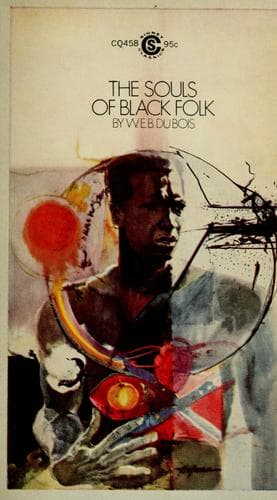
The Souls of Black FolkDu Bois, W. E. B. (William Edward Burghardt)
History
The Souls of Black Folk
Du Bois, W. E. B. (William Edward Burghardt)
African Americans
It is hardly necessary for me to add very much in regard to the social
contact between the races. Nothing has come to replace that finer
sympathy and love between some masters and house servants which the
radical and more uncompromising drawing of the color-line in recent
years has caused almost completely to disappear. In a world where it
means so much to take a man by the hand and sit beside him, to look
frankly into his eyes and feel his heart beating with red blood; in a
world where a social cigar or a cup of tea together means more than
legislative halls and magazine articles and speeches,—one can imagine
the consequences of the almost utter absence of such social amenities
between estranged races, whose separation extends even to parks and
streetcars.
Here there can be none of that social going down to the people,—the
opening of heart and hand of the best to the worst, in generous
acknowledgment of a common humanity and a common destiny. On the other
hand, in matters of simple almsgiving, where there can be no question
of social contact, and in the succor of the aged and sick, the South,
as if stirred by a feeling of its unfortunate limitations, is generous
to a fault. The black beggar is never turned away without a good deal
more than a crust, and a call for help for the unfortunate meets quick
response. I remember, one cold winter, in Atlanta, when I refrained
from contributing to a public relief fund lest Negroes should be
discriminated against, I afterward inquired of a friend: “Were any
black people receiving aid?” “Why,” said he, “they were _all_ black.”
And yet this does not touch the kernel of the problem. Human
advancement is not a mere question of almsgiving, but rather of
sympathy and cooperation among classes who would scorn charity. And
here is a land where, in the higher walks of life, in all the higher
striving for the good and noble and true, the color-line comes to
separate natural friends and coworkers; while at the bottom of the
social group, in the saloon, the gambling-hell, and the brothel, that
same line wavers and disappears.
I have sought to paint an average picture of real relations between the
sons of master and man in the South. I have not glossed over matters
for policy’s sake, for I fear we have already gone too far in that sort
of thing. On the other hand, I have sincerely sought to let no unfair
exaggerations creep in. I do not doubt that in some Southern
communities conditions are better than those I have indicated; while I
am no less certain that in other communities they are far worse.
Public-domain text, read in full here on John Shaqi.
Reviews
Reviews
No reviews yet
Be the first to share your thoughts on this work.
Elsewhere in the archive
Join the Discussion
Join the discussion
Sign in to leave a comment or review.
Sign InorCreate an account