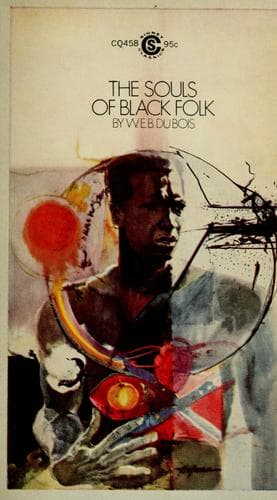
The Souls of Black FolkDu Bois, W. E. B. (William Edward Burghardt)
History
The Souls of Black Folk
Du Bois, W. E. B. (William Edward Burghardt)
African Americans
No sooner was the work thus started, and the general system and local
organization in some measure begun, than two grave difficulties
appeared which changed largely the theory and outcome of Bureau work.
First, there were the abandoned lands of the South. It had long been
the more or less definitely expressed theory of the North that all the
chief problems of Emancipation might be settled by establishing the
slaves on the forfeited lands of their masters,—a sort of poetic
justice, said some. But this poetry done into solemn prose meant either
wholesale confiscation of private property in the South, or vast
appropriations. Now Congress had not appropriated a cent, and no sooner
did the proclamations of general amnesty appear than the eight hundred
thousand acres of abandoned lands in the hands of the Freedmen’s Bureau
melted quickly away. The second difficulty lay in perfecting the local
organization of the Bureau throughout the wide field of work. Making a
new machine and sending out officials of duly ascertained fitness for a
great work of social reform is no child’s task; but this task was even
harder, for a new central organization had to be fitted on a
heterogeneous and confused but already existing system of relief and
control of ex-slaves; and the agents available for this work must be
sought for in an army still busy with war operations,—men in the very
nature of the case ill fitted for delicate social work,—or among the
questionable camp followers of an invading host. Thus, after a year’s
work, vigorously as it was pushed, the problem looked even more
difficult to grasp and solve than at the beginning. Nevertheless, three
things that year’s work did, well worth the doing: it relieved a vast
amount of physical suffering; it transported seven thousand fugitives
from congested centres back to the farm; and, best of all, it
inaugurated the crusade of the New England schoolma’am.
The annals of this Ninth Crusade are yet to be written,—the tale of a
mission that seemed to our age far more quixotic than the quest of St.
Louis seemed to his. Behind the mists of ruin and rapine waved the
calico dresses of women who dared, and after the hoarse mouthings of
the field guns rang the rhythm of the alphabet. Rich and poor they
were, serious and curious. Bereaved now of a father, now of a brother,
now of more than these, they came seeking a life work in planting New
England schoolhouses among the white and black of the South. They did
their work well. In that first year they taught one hundred thousand
souls, and more.
Public-domain text, read in full here on John Shaqi.
Reviews
Reviews
No reviews yet
Be the first to share your thoughts on this work.
Join the Discussion
Join the discussion
Sign in to leave a comment or review.
Sign InorCreate an account