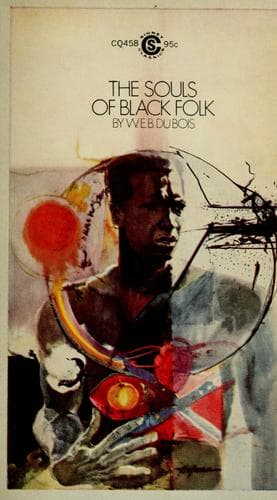
The Souls of Black FolkDu Bois, W. E. B. (William Edward Burghardt)
History
The Souls of Black Folk
Du Bois, W. E. B. (William Edward Burghardt)
African Americans
O water, voice of my heart, crying in the sand,
All night long crying with a mournful cry,
As I lie and listen, and cannot understand
The voice of my heart in my side or the voice of the sea,
O water, crying for rest, is it I, is it I?
All night long the water is crying to me.
Unresting water, there shall never be rest
Till the last moon droop and the last tide fail,
And the fire of the end begin to burn in the west;
And the heart shall be weary and wonder and cry like the sea,
All life long crying without avail,
As the water all night long is crying to me.
ARTHUR SYMONS.
[Illustration]
Between me and the other world there is ever an unasked question:
unasked by some through feelings of delicacy; by others through the
difficulty of rightly framing it. All, nevertheless, flutter round it.
They approach me in a half-hesitant sort of way, eye me curiously or
compassionately, and then, instead of saying directly, How does it feel
to be a problem? they say, I know an excellent colored man in my town;
or, I fought at Mechanicsville; or, Do not these Southern outrages make
your blood boil? At these I smile, or am interested, or reduce the
boiling to a simmer, as the occasion may require. To the real question,
How does it feel to be a problem? I answer seldom a word.
And yet, being a problem is a strange experience,—peculiar even for one
who has never been anything else, save perhaps in babyhood and in
Europe. It is in the early days of rollicking boyhood that the
revelation first bursts upon one, all in a day, as it were. I remember
well when the shadow swept across me. I was a little thing, away up in
the hills of New England, where the dark Housatonic winds between
Hoosac and Taghkanic to the sea. In a wee wooden schoolhouse, something
put it into the boys’ and girls’ heads to buy gorgeous
visiting-cards—ten cents a package—and exchange. The exchange was
merry, till one girl, a tall newcomer, refused my card,—refused it
peremptorily, with a glance. Then it dawned upon me with a certain
suddenness that I was different from the others; or like, mayhap, in
heart and life and longing, but shut out from their world by a vast
veil. I had thereafter no desire to tear down that veil, to creep
through; I held all beyond it in common contempt, and lived above it in
a region of blue sky and great wandering shadows. That sky was bluest
when I could beat my mates at examination-time, or beat them at a
foot-race, or even beat their stringy heads. Alas, with the years all
this fine contempt began to fade; for the words I longed for, and all
their dazzling opportunities, were theirs, not mine. But they should
not keep these prizes, I said; some, all, I would wrest from them. Just
how I would do it I could never decide: by reading law, by healing the
sick, by telling the wonderful tales that swam in my head,—some way.
With other black boys the strife was not so fiercely sunny: their youth
Public-domain text, read in full here on John Shaqi.
Reviews
Reviews
No reviews yet
Be the first to share your thoughts on this work.
Join the Discussion
Join the discussion
Sign in to leave a comment or review.
Sign InorCreate an account