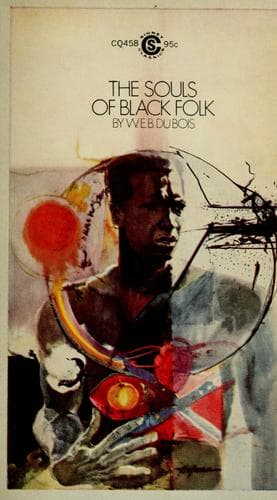
The Souls of Black FolkDu Bois, W. E. B. (William Edward Burghardt)
History
The Souls of Black Folk
Du Bois, W. E. B. (William Edward Burghardt)
African Americans
shrunk into tasteless sycophancy, or into silent hatred of the pale
world about them and mocking distrust of everything white; or wasted
itself in a bitter cry, Why did God make me an outcast and a stranger
in mine own house? The shades of the prison-house closed round about us
all: walls strait and stubborn to the whitest, but relentlessly narrow,
tall, and unscalable to sons of night who must plod darkly on in
resignation, or beat unavailing palms against the stone, or steadily,
half hopelessly, watch the streak of blue above.
After the Egyptian and Indian, the Greek and Roman, the Teuton and
Mongolian, the Negro is a sort of seventh son, born with a veil, and
gifted with second-sight in this American world,—a world which yields
him no true self-consciousness, but only lets him see himself through
the revelation of the other world. It is a peculiar sensation, this
double-consciousness, this sense of always looking at one’s self
through the eyes of others, of measuring one’s soul by the tape of a
world that looks on in amused contempt and pity. One ever feels his
twoness,—an American, a Negro; two souls, two thoughts, two
unreconciled strivings; two warring ideals in one dark body, whose
dogged strength alone keeps it from being torn asunder.
The history of the American Negro is the history of this strife,—this
longing to attain self-conscious manhood, to merge his double self into
a better and truer self. In this merging he wishes neither of the older
selves to be lost. He would not Africanize America, for America has too
much to teach the world and Africa. He would not bleach his Negro soul
in a flood of white Americanism, for he knows that Negro blood has a
message for the world. He simply wishes to make it possible for a man
to be both a Negro and an American, without being cursed and spit upon
by his fellows, without having the doors of Opportunity closed roughly
in his face.
Public-domain text, read in full here on John Shaqi.
Reviews
Reviews
No reviews yet
Be the first to share your thoughts on this work.
Join the Discussion
Join the discussion
Sign in to leave a comment or review.
Sign InorCreate an account