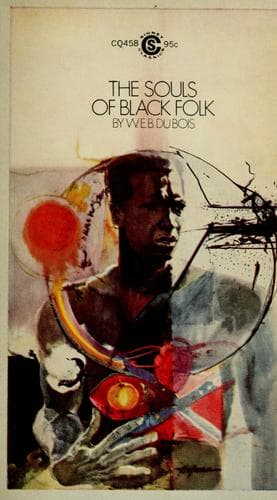
The Souls of Black FolkDu Bois, W. E. B. (William Edward Burghardt)
History
The Souls of Black Folk
Du Bois, W. E. B. (William Edward Burghardt)
African Americans
This, then, is the end of his striving: to be a co-worker in the
kingdom of culture, to escape both death and isolation, to husband and
use his best powers and his latent genius. These powers of body and
mind have in the past been strangely wasted, dispersed, or forgotten.
The shadow of a mighty Negro past flits through the tale of Ethiopia
the Shadowy and of Egypt the Sphinx. Through history, the powers of
single black men flash here and there like falling stars, and die
sometimes before the world has rightly gauged their brightness. Here in
America, in the few days since Emancipation, the black man’s turning
hither and thither in hesitant and doubtful striving has often made his
very strength to lose effectiveness, to seem like absence of power,
like weakness. And yet it is not weakness,—it is the contradiction of
double aims. The double-aimed struggle of the black artisan—on the one
hand to escape white contempt for a nation of mere hewers of wood and
drawers of water, and on the other hand to plough and nail and dig for
a poverty-stricken horde—could only result in making him a poor
craftsman, for he had but half a heart in either cause. By the poverty
and ignorance of his people, the Negro minister or doctor was tempted
toward quackery and demagogy; and by the criticism of the other world,
toward ideals that made him ashamed of his lowly tasks. The would-be
black savant was confronted by the paradox that the knowledge his
people needed was a twice-told tale to his white neighbors, while the
knowledge which would teach the white world was Greek to his own flesh
and blood. The innate love of harmony and beauty that set the ruder
souls of his people a-dancing and a-singing raised but confusion and
doubt in the soul of the black artist; for the beauty revealed to him
was the soul-beauty of a race which his larger audience despised, and
he could not articulate the message of another people. This waste of
double aims, this seeking to satisfy two unreconciled ideals, has
wrought sad havoc with the courage and faith and deeds of ten thousand
thousand people,—has sent them often wooing false gods and invoking
false means of salvation, and at times has even seemed about to make
them ashamed of themselves.
Public-domain text, read in full here on John Shaqi.
Reviews
Reviews
No reviews yet
Be the first to share your thoughts on this work.
Join the Discussion
Join the discussion
Sign in to leave a comment or review.
Sign InorCreate an account