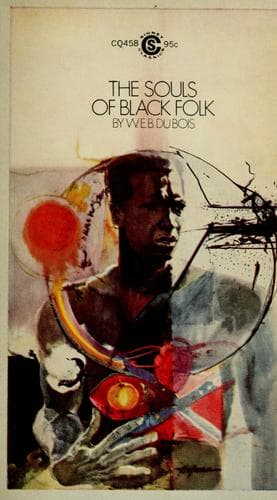
The Souls of Black FolkDu Bois, W. E. B. (William Edward Burghardt)
History
The Souls of Black Folk
Du Bois, W. E. B. (William Edward Burghardt)
African Americans
In the Black World, the Preacher and Teacher embodied once the ideals
of this people—the strife for another and a juster world, the vague
dream of righteousness, the mystery of knowing; but to-day the danger
is that these ideals, with their simple beauty and weird inspiration,
will suddenly sink to a question of cash and a lust for gold. Here
stands this black young Atalanta, girding herself for the race that
must be run; and if her eyes be still toward the hills and sky as in
the days of old, then we may look for noble running; but what if some
ruthless or wily or even thoughtless Hippomenes lay golden apples
before her? What if the Negro people be wooed from a strife for
righteousness, from a love of knowing, to regard dollars as the be-all
and end-all of life? What if to the Mammonism of America be added the
rising Mammonism of the re-born South, and the Mammonism of this South
be reinforced by the budding Mammonism of its half-wakened black
millions? Whither, then, is the new-world quest of Goodness and Beauty
and Truth gone glimmering? Must this, and that fair flower of Freedom
which, despite the jeers of latter-day striplings, sprung from our
fathers’ blood, must that too degenerate into a dusty quest of
gold,—into lawless lust with Hippomenes?
The hundred hills of Atlanta are not all crowned with factories. On
one, toward the west, the setting sun throws three buildings in bold
relief against the sky. The beauty of the group lies in its simple
unity:—a broad lawn of green rising from the red street and mingled
roses and peaches; north and south, two plain and stately halls; and in
the midst, half hidden in ivy, a larger building, boldly graceful,
sparingly decorated, and with one low spire. It is a restful group,
—one never looks for more; it is all here, all intelligible. There I
live, and there I hear from day to day the low hum of restful life. In
winter’s twilight, when the red sun glows, I can see the dark figures
pass between the halls to the music of the night-bell. In the morning,
when the sun is golden, the clang of the day-bell brings the hurry and
laughter of three hundred young hearts from hall and street, and from
the busy city below,—children all dark and heavy-haired,—to join their
clear young voices in the music of the morning sacrifice. In a
half-dozen class-rooms they gather then,—here to follow the love-song
of Dido, here to listen to the tale of Troy divine; there to wander
among the stars, there to wander among men and nations,—and elsewhere
other well-worn ways of knowing this queer world. Nothing new, no
time-saving devices,—simply old time-glorified methods of delving for
Truth, and searching out the hidden beauties of life, and learning the
good of living. The riddle of existence is the college curriculum that
was laid before the Pharaohs, that was taught in the groves by Plato,
that formed the _trivium_ and _quadrivium_, and is to-day laid before
the freedmen’s sons by Atlanta University.
Public-domain text, read in full here on John Shaqi.
Reviews
Reviews
No reviews yet
Be the first to share your thoughts on this work.
Join the Discussion
Join the discussion
Sign in to leave a comment or review.
Sign InorCreate an account