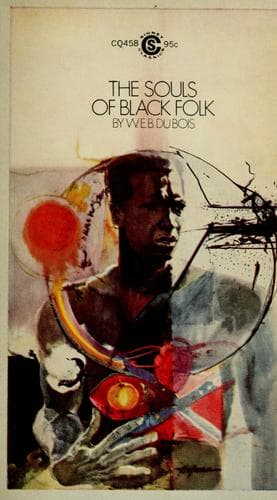
The Souls of Black FolkDu Bois, W. E. B. (William Edward Burghardt)
History
The Souls of Black Folk
Du Bois, W. E. B. (William Edward Burghardt)
African Americans
This was indeed the Egypt of the Confederacy,—the rich granary whence
potatoes and corn and cotton poured out to the famished and ragged
Confederate troops as they battled for a cause lost long before 1861.
Sheltered and secure, it became the place of refuge for families,
wealth, and slaves. Yet even then the hard ruthless rape of the land
began to tell. The red-clay sub-soil already had begun to peer above
the loam. The harder the slaves were driven the more careless and fatal
was their farming. Then came the revolution of war and Emancipation,
the bewilderment of Reconstruction,—and now, what is the Egypt of the
Confederacy, and what meaning has it for the nation’s weal or woe?
It is a land of rapid contrasts and of curiously mingled hope and pain.
Here sits a pretty blue-eyed quadroon hiding her bare feet; she was
married only last week, and yonder in the field is her dark young
husband, hoeing to support her, at thirty cents a day without board.
Across the way is Gatesby, brown and tall, lord of two thousand acres
shrewdly won and held. There is a store conducted by his black son, a
blacksmith shop, and a ginnery. Five miles below here is a town owned
and controlled by one white New Englander. He owns almost a Rhode
Island county, with thousands of acres and hundreds of black laborers.
Their cabins look better than most, and the farm, with machinery and
fertilizers, is much more business-like than any in the county,
although the manager drives hard bargains in wages. When now we turn
and look five miles above, there on the edge of town are five houses of
prostitutes,—two of blacks and three of whites; and in one of the
houses of the whites a worthless black boy was harbored too openly two
years ago; so he was hanged for rape. And here, too, is the high
whitewashed fence of the “stockade,” as the county prison is called;
the white folks say it is ever full of black criminals,—the black folks
say that only colored boys are sent to jail, and they not because they
are guilty, but because the State needs criminals to eke out its income
by their forced labor.
Public-domain text, read in full here on John Shaqi.
Reviews
Reviews
No reviews yet
Be the first to share your thoughts on this work.
Elsewhere in the archive
Join the Discussion
Join the discussion
Sign in to leave a comment or review.
Sign InorCreate an account