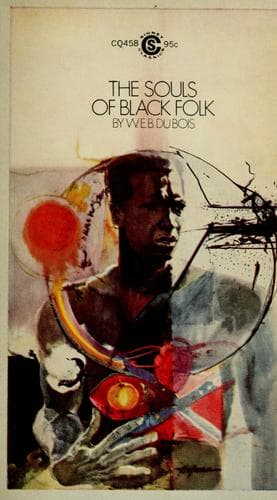
The Souls of Black FolkDu Bois, W. E. B. (William Edward Burghardt)
History
The Souls of Black Folk
Du Bois, W. E. B. (William Edward Burghardt)
African Americans
So dawned the time of _Sturm und Drang:_ storm and stress to-day rocks
our little boat on the mad waters of the world-sea; there is within and
without the sound of conflict, the burning of body and rending of soul;
inspiration strives with doubt, and faith with vain questionings. The
bright ideals of the past,—physical freedom, political power, the
training of brains and the training of hands,—all these in turn have
waxed and waned, until even the last grows dim and overcast. Are they
all wrong,—all false? No, not that, but each alone was over-simple and
incomplete,—the dreams of a credulous race-childhood, or the fond
imaginings of the other world which does not know and does not want to
know our power. To be really true, all these ideals must be melted and
welded into one. The training of the schools we need to-day more than
ever,—the training of deft hands, quick eyes and ears, and above all
the broader, deeper, higher culture of gifted minds and pure hearts.
The power of the ballot we need in sheer self-defence,—else what shall
save us from a second slavery? Freedom, too, the long-sought, we still
seek,—the freedom of life and limb, the freedom to work and think, the
freedom to love and aspire. Work, culture, liberty,—all these we need,
not singly but together, not successively but together, each growing
and aiding each, and all striving toward that vaster ideal that swims
before the Negro people, the ideal of human brotherhood, gained through
the unifying ideal of Race; the ideal of fostering and developing the
traits and talents of the Negro, not in opposition to or contempt for
other races, but rather in large conformity to the greater ideals of
the American Republic, in order that some day on American soil two
world-races may give each to each those characteristics both so sadly
lack. We the darker ones come even now not altogether empty-handed:
there are to-day no truer exponents of the pure human spirit of the
Declaration of Independence than the American Negroes; there is no true
American music but the wild sweet melodies of the Negro slave; the
American fairy tales and folklore are Indian and African; and, all in
all, we black men seem the sole oasis of simple faith and reverence in
a dusty desert of dollars and smartness. Will America be poorer if she
replace her brutal dyspeptic blundering with light-hearted but
determined Negro humility? or her coarse and cruel wit with loving
jovial good-humor? or her vulgar music with the soul of the Sorrow
Songs?
Merely a concrete test of the underlying principles of the great
republic is the Negro Problem, and the spiritual striving of the
freedmen’s sons is the travail of souls whose burden is almost beyond
the measure of their strength, but who bear it in the name of an
historic race, in the name of this the land of their fathers’ fathers,
and in the name of human opportunity.
Public-domain text, read in full here on John Shaqi.
Reviews
Reviews
No reviews yet
Be the first to share your thoughts on this work.
Join the Discussion
Join the discussion
Sign in to leave a comment or review.
Sign InorCreate an account