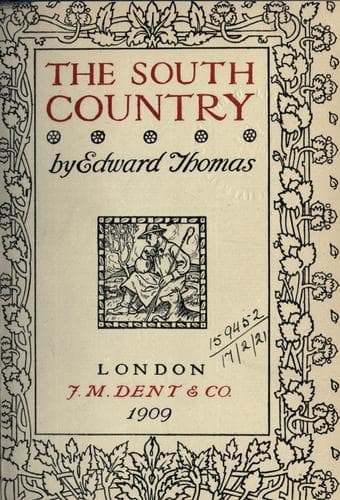
England -- Description and travel; Natural history -- England; Thomas, Edward, 1878-1917 -- Travel -- England
But at morning twilight I see the moon low in the west like a broken
and dinted shield of silver hanging long forgotten outside the tent of
a great knight in a wood, and inside are the knight’s bones clean and
white about his rusted sword. In the east the sun rises, a red-faced
drover and a million sheep going before him silent over the blue
downs of the dawn: and I am ill-content and must watch for a while
the fraying, changeful edges of the lesser clouds drift past and into
the great white ones above, or hear rebellious music that puts for
one brief hour into our hands the reins of the world that we may sit
mightily behind the horses and drive to the goal of our dreams.
A footpath leads from the Pilgrims’ Way past the divine undulations and
beech glades of a park--a broad piece of the earth that flows hither
and thither in curves, sudden or slow but flawless and continuous, and
everywhere clothed in a seamless garment of grass. The path crosses
the white main road into a lesser one that traverses a common of
beech and oak and birch. The leaves make an unbroken roof over the
common: except the roads there is not a path in it. For it is a small
and narrow strip of but a few acres, without any open space, gloomy,
much overgrown by thickets. Last year’s leaves lie undisturbed and of
the colour of red deer under the silky green new foliage and round
the huge mossy pedestals of beech and in caves behind the serpentine
locked roots. No child’s shout is heard. No lover walks there. The
motor-car hurries the undesirable through and down into the Weald. And
so it is alone and for themselves that the beeches rise up in carven
living stone and expand in a green heaven for the song of the woodwren,
pouring out pearls like wine.
Southward, on either side of the steep road, the slope is, below
the beeches, given to corn and hops; at the foot are all the oaks
and pasture of the Weald, diversified by hop gardens on many of
the slanting fields that break up its surface. Looking back from
here the hills above are less finely modelled than the downs still
farther behind us in the north. But they also have their shallow
coombes, sometimes two tiers of them, and they are indented by deep,
wide-mouthed bays. One of them begins in copses of oak and hazel and
sallow, a little arable, a farm, three oast cones, and a little steep
orchard in a hollow of their own, which give way to hops, followed by
grass and then a tortuous ploughland among the oaks and firs of the
great woods that cover the more precipitous sides of the upper end of
the bay. Exquisitely cultivated, this bay is yet a possession of cuckoo
and nightingale, singing under the yellow-green and black-branched oaks
and above the floor of bluebell and dark dog’s mercury.
Out of the coombe a deep lane ascends through beech, hazel and beam to
another common of heather, and whinberry bathing the feet of scattered
birch, and squat oak and pine, interrupted by yellow gravel pits.
Public-domain text, read in full here on John Shaqi.
Reviews
Reviews
No reviews yet
Be the first to share your thoughts on this work.
Join the Discussion
Join the discussion
Sign in to leave a comment or review.
Sign InorCreate an account