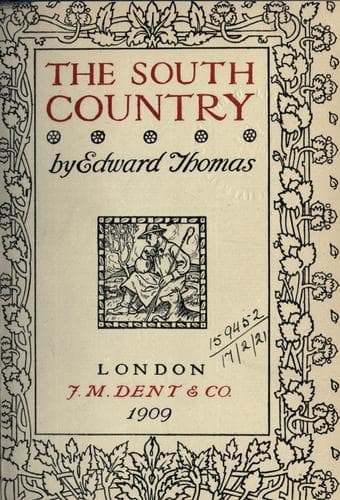
England -- Description and travel; Natural history -- England; Thomas, Edward, 1878-1917 -- Travel -- England
The road skirts the marshland, the stream and the town, and goes
through a gap in the Downs towards another range and more elms
and farms at its feet. Stately walks the carter’s boy with his
perpendicular brass-bound whip, alongside four waggon-horses, while the
carter rides. It is a pleasant thing to see them going to their work in
the early gold of the morning, fresh, silent, their horses jingling,
down the firm road. If they were leading their team to yoke them to the
chariot of the sun they could not be more noble. They are the first men
I have seen this morning, and truly they create for a little while the
illusion that they are going to guide the world and that all will be
well in the golden freshness under the blue.
The road now divides to go round the base of the Downs, but a farm
track sets out to climb them. There, at the corner, is a church, on
the very edge of the flat vale and its elms and ashes in the midst of
meadows; a plain towered church, but with a rough churchyard, half
graveyard and half orchard, its grass and parsley and nettle uncut
under the knotty apple trees, splashed with silver and dull gold-green,
dotted by silver buds among yellow-lichened branches that are matted
densely as a magpie’s nest. The dust from the high road powders the
nettles and perfects the arresting melancholy of the desolation, so
quiet, so austere, and withal as airy as a dream remembered. But above
are the Downs, green and sweet with uplifting grass, and beyond them
the sea, darkly gleaming under lustrous white cliffs and abrupt ledges
of turf, in the south; in the south-east a procession of tufted trees
going uphill in single file; in the south-west the dazzling slate
roofs of a distant town, two straight sea walls and two steamers and
their white wakes; northward the most beautiful minor range in all the
downland, isolated by a river valley at the edge of which it ends in a
gulf of white quarry, while on the other side it heaves and flows down
almost to the plain, but rises again into a lesser hill with woods,
and then slowly subsides. Within a few square miles it collects every
beauty of the chalk hill; its central height is a dome of flawless
grass only too tender to be majestic; and that is supported by lesser
rounds and wavering lines of approach in concavity and convexity,
playgrounds for the godlike shadows and lights, that prolong the
descent of the spent wave of earth into the plain.
Public-domain text, read in full here on John Shaqi.
Reviews
Reviews
No reviews yet
Be the first to share your thoughts on this work.
Join the Discussion
Join the discussion
Sign in to leave a comment or review.
Sign InorCreate an account