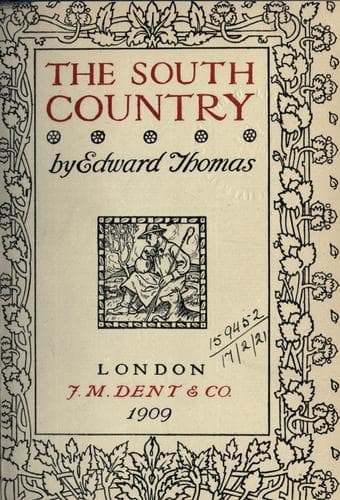
England -- Description and travel; Natural history -- England; Thomas, Edward, 1878-1917 -- Travel -- England
Then in the early morning the air is still and warm, but so moist that
there is a soul of coolness in the heat, and never before were the
leaves of the sorrel and wood sanicle and woodruff, and the grey-green
foliage and pallid yellow flowers of the large celandine, so fair.
The sudden wren’s song is shrewd and sweet and banishes heaviness.
The huge chestnut tree is flowering and full of bees. The parsley
towers delicately in bloom. The beech boughs are encased in gliding
crystal. The nettles, the millions of nettles in a bed, begin to smell
of summer. In the calm and sweet air the turtle-doves murmur and the
blackbirds sing--as if time were no more--over the mere.
The roads, nearly dry again, are now at their best, cool and yet
luminous, and at their edges coloured rosy or golden brown by the
sheddings of the beeches, those gloves out of which the leaves have
forced their way, pinched and crumpled by the confinement. At the bend
of a broad road descending under beeches these parallel lines of ruddy
chaff give to two or three days in the year a special and exquisite
loveliness, if the weather be alternately wet and bright and the long
white roads and virgin beeches are a temptation. What quests they
propose! They take us away to the thin air of the future or to the
underworld of the past. This one takes us to the old English sweetness
and robustness of an estate of large meadows, sound oak trees not too
close together, and a noble house within an oak-paled park. A poet
and a man lives there, one who recalls those other poets--they are
not many--who please us over the gulf of time almost as much by the
personal vigour and courage which we know to have been theirs or is
suggested by their work, men like Chaucer, Sidney, Ben Jonson, Drayton,
Byron, William Morris, and among the living ---- and ---- and ----.
I think we should miss their poems more than some greater men’s if
they were destroyed. They stand for their time more clearly than the
greatest. For example, Chaucer’s language, ideas and temper make it
impossible for us to read his work, no matter in how remote a study
or garden, shut out from time and change, without feeling that he and
all those who rode, and talked and were young with him are skeletons
or less, though Catullus or Milton may be read with no such feeling.
Chaucer seems to remind us of what once we were. His seems a golden
age. He wrote before Villon had inaugurated modern literature with the
cry--
_Mais où sont les neiges d’antan?_
Public-domain text, read in full here on John Shaqi.
Reviews
Reviews
No reviews yet
Be the first to share your thoughts on this work.
Join the Discussion
Join the discussion
Sign in to leave a comment or review.
Sign InorCreate an account