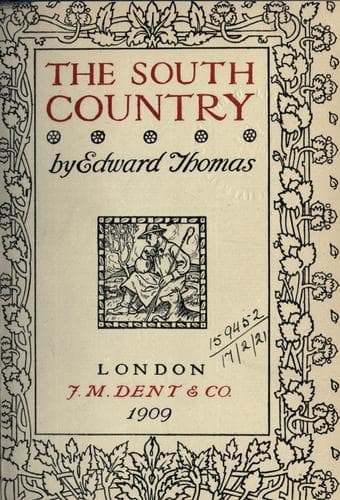
England -- Description and travel; Natural history -- England; Thomas, Edward, 1878-1917 -- Travel -- England
before men appear to us to have learned how immense is the world and
time. But we, looking back, with the help of this knowledge, see in
the work of this man who filled a little nook of time and space with
gaiety, something apart from us, an England, a happy island which his
verses made. His gaiety bathes the land in the light of a golden age
and the freshness of all the May days we can never recover. He “led a
lusty life in May”: “in his lust present was all his thought.” And the
gaiety is no less in the sorrowful passages than in the joyful; when,
for example, he compares the subjection of the fierce, proud Troilus to
love, with the whipping of a spirited horse; when he uses the apparent
commonplace about age creeping in “always as still as stone” upon fresh
youth; when he exclaims to the false Jason--
Have at thee, Jason! now thy horne is blowe;
or cries at the fate of Ugolino’s children--
Allas, Fortune! it was greet crueltee
Swiche briddes for to putte in swich a cage!
Even in Griselda’s piteous cry--
O tendre, O deere, O yonge children myne,
there is an intimation that in those words her sorrow is being spent
and that, though it will be renewed, it will be broken up by joyfulness
many times before her death. For, as Chaucer’s laughter is assuredly
never completed by a sigh, so there is something hearty in his tears
that hints of laughter before and after. His was a sharp surprising
sorrow that came when he was forced to see the suffering of lovely
humanity. He is all gaiety; but it has two moods. Sorrow never changes
him more than shadow changes a merry brook. In both moods he seems to
speak of a day when men had not only not so far outstripped the lark
and nightingale as we have done, but had moments when their joy was
equal to the lark’s above the grey dew of May dawns. And thus, if we
only had to thank Chaucer for the gaiety which is left behind in his
poems, as the straw of a long-past harvest clings to the thorns of a
narrow lane, we could never be thankful enough.
I feel that Chaucer was the equal of those of whom he wrote, as Homer
was the equal of Achilles and Odysseus, just as Byron was the peer of
the noblest of the Doges and of the ruined Emperor whom he addressed
as--
Vain froward child of Empire! say
Are all thy playthings snatched away?
Public-domain text, read in full here on John Shaqi.
Reviews
Reviews
No reviews yet
Be the first to share your thoughts on this work.
Join the Discussion
Join the discussion
Sign in to leave a comment or review.
Sign InorCreate an account