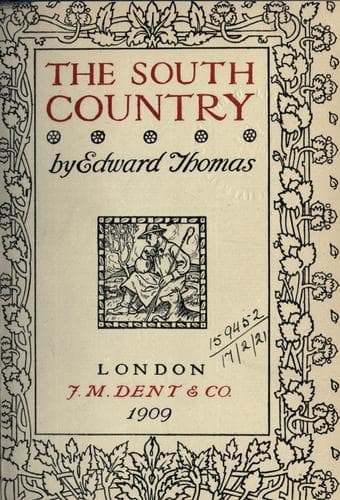
England -- Description and travel; Natural history -- England; Thomas, Edward, 1878-1917 -- Travel -- England
Byron is one of the few poets whose life it was ever necessary to
write. His acts were representative; from his Harrow meditations on
a tomb to his death on the superb pedestal of Missolonghi, they are
symbolic. His life explains nearly everything in his poetry. The life
and the poetry together make an incomparable whole. Most lives of
poets stand to their work as a block of unhewn marble stands to the
statue finished and unveiled; if the marble is not as much forgotten
as was Pygmalion’s when Galatea breathed and sighed. Byron’s poetry
without his life is not finished; but with it, it is like a statue
by Michael Angelo or Rodin that is actually seen to grow out of the
material. He was a man before he was a poet. Other poets may once have
been men; they are not so now. We read their lives after their poetry
and we forget them. It is by their poetry that they survive--blithe
or pathetic or glorious, but dim, ghosts who are become a part of
the silence of libraries and lovers’ hearts. They are dead but for
the mind that enjoys and the voice that utters their verse. I had
not the smallest curiosity about Mr. Swinburne when he was alive and
visible. When I think of him, I think of Rosamund speaking to Eleanor
or Tristram to Isoud; he has given up his life to them. But with Byron
it is different. If all record of him could be destroyed, more than
half of him would be lost. For I think that it is upon the life and the
portraits and the echoes that are still reverberating in Europe, that
we found our belief that he is a great man. Without them he would be
an interesting rhetorician, perhaps little more. There are finer poems
than his “Mazeppa,” but the poet is the equal of that wild lover and of
the great King who slept while the tale was told.
And Shelley, too, is an immortal sentiment. Men may forget to
repeat his verses; they can never be as if Shelley had never been.
He is present wherever love and rapture are. He is a part of all
high-spirited and pure audacity of the intellect and imagination, of
all clean-handed rebellion, of all infinite endeavour and hope. The
remembered splendour of his face is more to us than Parliaments; one
strophe of his odes is more nourishing than a rich man’s gold....
Under those oaks in May I could wish to see these men walking together,
to see their gestures and brave ways. It is the poet there who all but
creates them for me. But only one can I fairly see because I have seen
him alive and speaking. Others have sent up their branches higher among
the stars and plunged their roots deeper among the rocks and waters.
But he and Chaucer and Jonson and Byron have obviously much plain
humanity in their composition. They have a brawn and friendliness not
necessarily connected with poetry. We use no ceremony--as we do with
some other poets--with Morris when we read--
Public-domain text, read in full here on John Shaqi.
Reviews
Reviews
No reviews yet
Be the first to share your thoughts on this work.
Join the Discussion
Join the discussion
Sign in to leave a comment or review.
Sign InorCreate an account