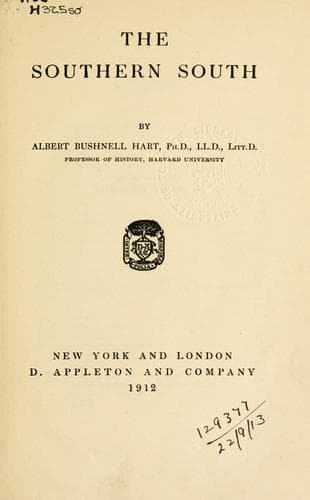
Southern States -- Social conditions; United States -- Race relations
"The most progressive nations have now definitely come to the conclusion
that there is no mode of increasing industrial and commercial efficiency
so effective as universal education sufficiently prolonged to effect
permanent improvement in the observing and reasoning powers of the
children." So said that primate of American education, President Eliot, in
an address at Tuskegee, Ala. Though speaking before an audience chiefly
composed of colored people, he was laying down a general principle, for he
goes on to say that in the Southern states "for both whites and blacks the
school time is too short; a large proportion of the children leave school
at too early an age; well-trained teachers are lacking; and the range and
variety of accessible instruction are too small. Hence a large proportion
of both the white race and the black race in the South are in urgent need
of better facilities for education."
This is one point of view; at the other extremity stand such men as a
Southern editor who has recently written, "As an educational influence the
investment of $100,000 in a cotton mill is worth ten times the $100,000
given a Southern college." What does the South as a whole think on this
question of education? What are its needs? What has it so far done? What
is it prepared to do? How does education affect the race question?
Throughout the South there has been and still persists an excellent
tradition of reading and of education among the classes which may be
presumed to afford such advantages for their children. Classical allusions
and quotations from Scripture and Shakespeare are still recognized by all
well-educated men. Some of the few fine old plantation houses contain
elegantly appointed libraries, stopping short, however, at the year 1836,
or whenever the owner died. The city of Charleston has better bookstores
than the city of Albany. Probably more people in North Carolina can
comment on Shakespeare than in Maine; and the man who can read Horace
without a pony and quote Greek without looking at the book is a public
character. Besides this admiration for an old-fashioned learning that is
now passing, the South feels a genuine and lively interest in what goes on
in the world. The present generation of fairly well-to-do people travel
more, see more, read more that is written in their own time, think more
than did their fathers and grandfathers. They feel a genuine interest in
education, put intelligent thought on methods, show respect for the
colleges, are willing to spend money on schools.
Public-domain text, read in full here on John Shaqi.
Reviews
Reviews
No reviews yet
Be the first to share your thoughts on this work.
Elsewhere in the archive
Join the Discussion
Join the discussion
Sign in to leave a comment or review.
Sign InorCreate an account