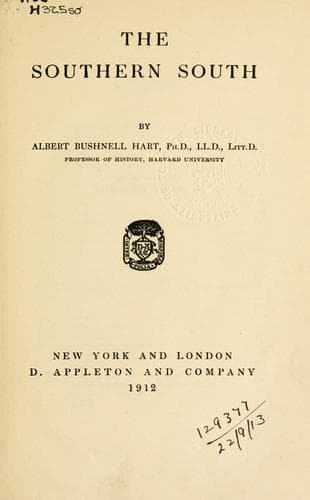
Southern States -- Social conditions; United States -- Race relations
A part of the problem is the spirit of those who write formal books, and a
group of works may be enumerated which take an extreme anti-Negro view and
seek to throw upon the African race the responsibility for whatever is
wrong in the South. Dr. R. W. Shufeldt (late of the United States army)
has published "The Negro a Menace to American Civilization" (1907), of
which the theme is sufficiently set forth by the wearisome use of the term
"hybrid" for mulatto; he illustrates his book, supposed to be a logical
argument on the inferiority of the Negro, with reproductions of
photographs showing the torture and death of a Negro in process of
lynching by a white mob; and he sums up his judgment of the negro race in
the phrase "The Negro in fact has no morals, and it is therefore out of
the question for him to be immoral."
The most misleading of all the Southern writers is Thomas Dixon, Jr., a
man who is spending his life in the attempt to persuade his neighbors that
the North is passionately hostile to the South; that the black is bent on
dishonoring the white race; and that the ultimate remedy is extermination.
In his three novels, "The Leopard's Spots" (1902), "The Clansman" (1905),
and "The Traitor" (1907), he paints a lurid picture of Reconstruction, in
which the high-toned Southern gentleman tells the white lady who wishes to
endow a college for Negroes that he would like--"to box you up in a glass
cage, such as are used for rattlesnakes, and ship you back to Boston." One
of these novels, "The Clansman," has been dramatized, and its production,
against the remonstrances of the respectable colored people in a Missouri
town, led directly to a lynching. No reasonable being would hold the whole
South responsible for such appeals to passion; but unfortunately many
well-meaning people accept that responsibility. In Charlotte, N. C., the
most refined and respectable white people went to see "The Clansman"
played and showed every sign of approval, as appears to have been the case
in Providence, R. I., in 1909. A recent writer, John C. Reed, in his
"Brothers' War," brackets Thomas Dixon, Jr., with John C. Calhoun as
exponents of Southern feeling and especially lauds Dixon as the "exalted
glorification" of the Ku Klux.
Public-domain text, read in full here on John Shaqi.
Reviews
Reviews
No reviews yet
Be the first to share your thoughts on this work.
Join the Discussion
Join the discussion
Sign in to leave a comment or review.
Sign InorCreate an account