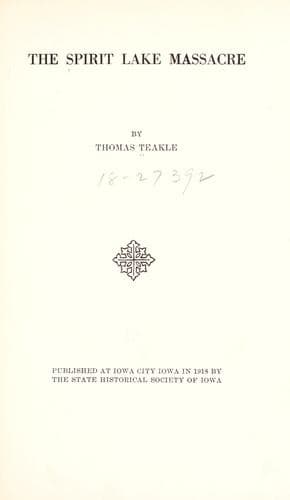
Indians of North America -- Iowa; Spirit Lake Massacre, Iowa, 1857
Accustomed to the matching of intellects, the whites frequently
resorted to the stilted verbiage of treaties in their efforts to push
the Indian farther toward the setting sun. In these treaties the red
man found much cause for complaint--not so much in the strict wording
of the documents themselves as in the management of affairs they
induced. This too often exasperated and provoked the Indian.[5] To
him the Iowa country was a paradise. Not only was it his home and
hunting ground, but here centered much of the traditional lore of his
tribe and race. Thus Iowa was doubly dear to him and worth his most
determined effort to hold. As the wave of settlements advanced, the
Indian was induced to sell--sometimes under circumstances provoking a
strong suspicion of compulsion rather than voluntary agreement in the
transfer. He felt instinctively that he had to retire, but in his
racial pride he resented the necessity. He knew well the later
traditions of his race, in the light of which he could foresee that in
a very brief time force, which “comprises the elements of all Indian
treaties”,[6] would be used to drive him from his domain.
As tract after tract was ceded, lands that the Indian did not want
were given to him in exchange--lands devoid of good camping places and
wanting in such game as was essential to his very existence. Moreover,
the very lands the Indians prized most were the most sought for by the
whites. The qualities causing them to be prized by the one made them
desirable for the other. Thus the Indian’s subsistence became so
precarious that often he was on the verge of starvation. Coupled with
this deprivation of favorite pleasure and hunting grounds was the
white man’s idealistic dream of civilizing the Indian by making him
work at tilling the soil or at the various trades. This seemed to the
haughty red man a real degradation. He could die fighting, if need be;
but work he would not. His steadfast refusal to work or become
civilized could only end in banishment from the lands he valued so
highly. In view of this policy of forcing him into an involuntary
exile, one ceases to wonder that he grew discontented and rebelled
rather than submit.[7] He could not have done otherwise and retain his
pride of race.
Forcible dispossession of his ancestral hunting ranges, however, would
not have provoked in him an overweening hatred for the white man if it
had not been so often coupled with a show of military force. The sole
purpose of such military campaigns seems to have been to frighten the
Indian in order that he might learn to be peaceful and pliant through
fear of punishment.
Public-domain text, read in full here on John Shaqi.
Reviews
Reviews
No reviews yet
Be the first to share your thoughts on this work.
Join the Discussion
Join the discussion
Sign in to leave a comment or review.
Sign InorCreate an account