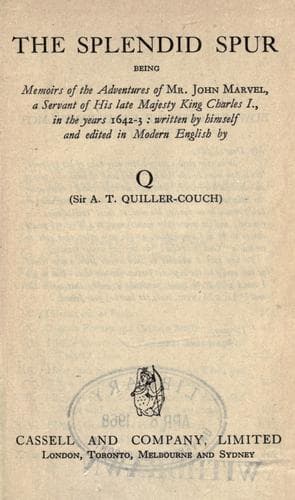
The Splendid Spur: Being Memoirs of the Adventures of Mr. John Marvel, a Servant of His Late Majesty King Charles I, in the Years 1642-3 — John Shaqi
The Splendid Spur: Being Memoirs of the Adventures of Mr. John Marvel, a Servant of His Late Majesty King Charles I, in the Years 1642-3Quiller-Couch, Arthur
History
The Splendid Spur: Being Memoirs of the Adventures of Mr. John Marvel, a Servant of His Late Majesty King Charles I, in the Years 1642-3
Quiller-Couch, Arthur
Great Britain -- History -- Charles I, 1625-1649 -- Fiction
The interesting question is not so much, What has he done to be the only
prominent Q of these years, as Is he to be the Q of all time? If so, he
will do better work than he has yet done, though several of his latest
sketches—and one in particular—are of very uncommon merit. Mr.
Quiller-Couch is so unlike Mr. Kipling that one immediately wants to
compare them. They are both young, and they have both shown such promise
that it will be almost sad if neither can write a book to live—as,
of course, neither has done as yet. Mr. Kipling is the more audacious,
which is probably a matter of training. He was brought up in India,
where one’s beard grows much quicker than at Oxford, and where you not
only become a man (and a cynic) in a hurry, but see and hear strange
things (and print them) such as the youth of Oxford miss, or, becoming
acquainted with, would not dare insert in the local magazine of the
moment. So Mr. Kipling’s first work betokened a knowledge of the world
that is by no means to be found in “Dead Man’s Rock,” the first book
published by Mr. Quiller-Couch. On the other hand, it cannot truly be
said that Mr. Kipling’s latest work is stronger than his first, while
the other writer’s growth is the most remarkable thing about him. It
is precisely the same Mr. Kipling who is now in the magazines that was
writing some years ago in India (and a rare good Mr. Kipling too), but
the Mr. Quiller-Couch of to-day is the Quiller-Couch of “Dead Man’s
Rock” grown out of recognition. To compare their styles is really to
compare the men. Mr. Kipling’s is the more startling, the stronger (as
yet), and the more mannered. Mark Twain, it appears, said he reads Mr.
Kipling for his style, which is really the same thing as saying you read
him for his books, though the American seems only to have meant that
he eats the beef because he likes the salt. It is a journalistic style,
aiming too constantly at sharp effects, always succeeding in getting
them. Sometimes this is contrived at the expense of grammar, as when (a
common trick with the author) he ends a story with such a paragraph as
“Which is manifestly unfair.” Mr. Quiller-Couch has never sinned in this
way, but his first style was somewhat turgid, even melodramatic, and,
compared with Mr. Kipling’s, lacked distinction. From the beginning Mr.
Kipling had the genius for using the right word twice in three
times (Mr. Stevenson only misses it about once in twelve), while
Mr. Quiller-Couch not only used the wrong word, but weighted it with
adjectives. The charge, however, cannot be brought against him to-day,
for having begun by writing like a Mr. Haggard not quite sure of himself
(if one can imagine such a Mr. Haggard), and changing to an obvious
imitation of Mr. Stevenson, he seems now to have made a style for
himself. It is clear and careful, but not as yet strong winged. Its
distinctive feature is that it is curiously musical.
Public-domain text, read in full here on John Shaqi.
Reviews
Reviews
No reviews yet
Be the first to share your thoughts on this work.
Join the Discussion
Join the discussion
Sign in to leave a comment or review.
Sign InorCreate an account