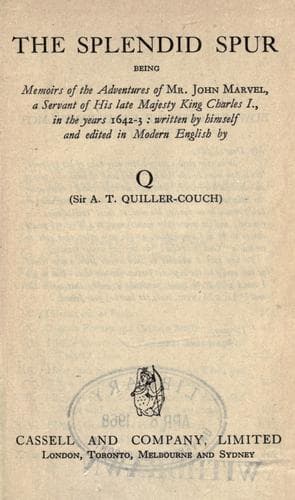
The Splendid Spur: Being Memoirs of the Adventures of Mr. John Marvel, a Servant of His Late Majesty King Charles I, in the Years 1642-3Quiller-Couch, Arthur
History
The Splendid Spur: Being Memoirs of the Adventures of Mr. John Marvel, a Servant of His Late Majesty King Charles I, in the Years 1642-3
Quiller-Couch, Arthur
Great Britain -- History -- Charles I, 1625-1649 -- Fiction
“Dead Man’s Rock” is a capital sensational story to be read and at once
forgotten. It was followed by “The Astonishing History of Troy Town,”
which was humorous, and proved that the author owed a debt to Dickens.
But it was not sufficiently humorous to be remarkable for its humor, and
it will go hand in hand with “Dead Man’s Rock” to oblivion. Until “The
Splendid Spur” appeared Mr. Quiller-Couch had done little to suggest
that an artist had joined the ranks of the story-tellers. It is not in
anyway a great work, but it was among the best dozen novels of its year,
and as the production of a new writer it was one of the most notable.
About the same time was published another historical romance of the
second class (for to nothing short of Sir Walter shall we give a
first-class in this department), “Micah Clarke,” by Mr. Conan Doyle. It
was as inevitable that the two books should be compared as that he who
enjoyed the one should enjoy the other. In one respect “Micah Clarke” is
the better story. It contains one character, a soldier of fortune, who
is more memorable than any single figure in “The Splendid Spur.” This,
however, is effected at a cost, for this man is the book. It contains,
indeed, two young fellows, one of them a John Ridd, but no Diana Vernon
would blow a kiss to either. Both stories are weak in pathos, despite
Joan, but there are a score of humorous situations in “The Splendid
Spur” that one could not forget if he would—which he would not—as, for
instance, where hero and heroine are hidden in barrels in a ship, and
hero cries through his bunghole, “Wilt marry me, sweetheart?” to which
heroine replies, “Must get out of this cask first.” Better still is the
scene in which Captain Billy expatiates, with a mop and a bucket, on the
merits of his crew. But the passages are for reading, not for hearing
about. Of the characters, this same Captain Billy is not the worst, but
perhaps the best is Joan, Mr. Quiller-Couch’s first successful picture
of a girl. A capital eccentric figure is killed (some good things
are squandered in this book) just when we are beginning to find him a
genuine novelty. Anything that is ready to leap into danger seems to
be thought good enough for the hero of a fighting romance, so that Jack
Marvel will pass (though Delia, as is right and proper, is worth two of
him, despite her coming-on disposition). The villain is a failure, and
the plot poor. Nevertheless there are some ingenious complications in
it. Jack’s escape by means of the hangman’s rope, which was to send him
out of the world in a few hours, is a fine rollicking bit of sensation.
Where Mr. Quiller-Couch and Mr. Conan Doyle both fail as compared with
the great master of romance is in the introduction of historical figures
and episodes. Scott would have been a great man if he had written no
novel but “The Abbott” (one of his second best), and no part of
“The Abbott” but the scene in which Mary signs away her crown. Mr.
Public-domain text, read in full here on John Shaqi.
Reviews
Reviews
No reviews yet
Be the first to share your thoughts on this work.
Join the Discussion
Join the discussion
Sign in to leave a comment or review.
Sign InorCreate an account