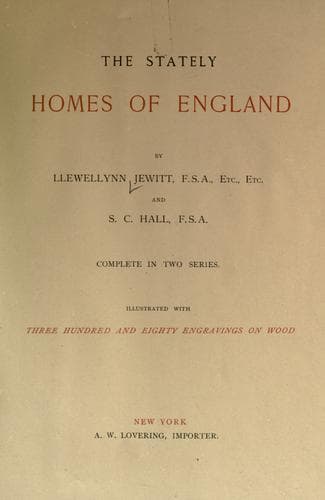
The Stately Homes of EnglandJewitt, Llewellynn Frederick William
History
The Stately Homes of England
Jewitt, Llewellynn Frederick William
Historic buildings -- England
volume of his
poems in the Lansdowne Collection in the British Museum, although so
well known, will bear repeating here:—
“Underneath this sable hearse
Lies the subject of all verse,
_Sidney’s_ sister! _Pembroke’s_ mother
Death, ere thou hast slain another
Fair, and learn’d, and good as she,
Time shall throw a dart at thee!
Marble piles let no man raise
To her name for after-days;
Some kind woman, born as she,
Reading this, like Niobe,
Shall turn marble, and become
Both her mourner and her tomb.”
Again, however, Sidney returned to court, and his queen seized every
opportunity to do him honour. He received her smiles with the same high
and manly gallantry, the same plain and simple boldness, with which
he had taken her frowns. In the end, Elizabeth, who, to preserve this
“jewel of her crown,” had forcibly laid hands on him when he projected
a voyage to America with Sir Francis Drake, and placed her veto on his
quitting England when he was offered the crown of Poland, could not
restrain his bravery in battle when circumstances called him there. At
Zutphen, on the 22nd of September, 1586, he received a mortal wound;
and here occurred the touching incident to which, perhaps, more than
to any other circumstance, Sir Philip is indebted for his heroic fame.
It is thus related by his friend and biographer, Fulke Greville, Lord
Broke:—“In his sad progress, passing along by the rest of the army,
where his uncle, the general, was, and being thirsty from excess of
bleeding, he called for drink, which was presently brought him; but, as
he was putting the bottle to his mouth, he saw a poor soldier carried
along, who had been wounded at the same time, ghastly, casting up his
eyes at the bottle; which Sir Philip perceiving, took it from his head
before he drank, and delivered to the poor man with these words: ‘Thy
necessity is yet greater than mine.’ He lived in great pain for many
days after he was wounded, and died on the 17th of October, 1586.” The
close of his life affords a beautiful lesson. “Calmly and steadily he
awaited the approach of death. His prayers were long and fervent; his
bearing was indeed that of a Christian hero.” He had a noble funeral;
kings clad themselves in garments of grief: a whole people grieved for
the loss of the most accomplished scholar, the most graceful courtier,
the best soldier, and the worthiest man of the country and the age.
He was buried in state, in the old Cathedral of St. Paul, on the 16th
of February. Both Universities composed verses to his memory, and so
general was the mourning for him, that, “for many months after his
death, it was accounted indecent for any gentleman of quality to appear
at court or in the city in any light or gaudy apparel.”
Public-domain text, read in full here on John Shaqi.
Reviews
Reviews
No reviews yet
Be the first to share your thoughts on this work.
Elsewhere in the archive
Join the Discussion
Join the discussion
Sign in to leave a comment or review.
Sign InorCreate an account