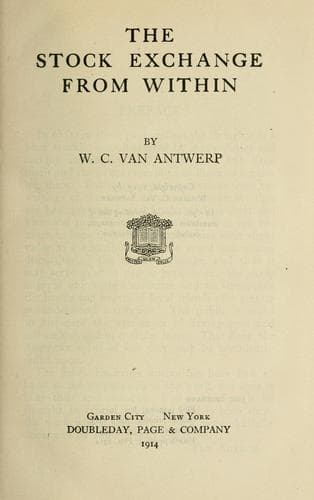
The Stock Exchange from WithinVan Antwerp, William C. (William Clarkson)
History
The Stock Exchange from Within
Van Antwerp, William C. (William Clarkson)
New York Stock Exchange; Stock exchanges
In another chapter I shall describe the method by which the Stock
Exchange protects its patrons, the public. As this is of particular
importance in connection with the matters just cited, I call the
reader’s attention to the remarks of Prof. S. S. Huebner, Ph.D., of the
University of Pennsylvania.
“Importance must be attached to the protection and safeguards
which organized Stock Exchanges give the stock and bond holder, in
regulating brokerage transactions and maintaining a standard of
commercial honor among brokers.... In this connection it should be
remembered that the constitution of nearly every Stock Exchange
defines the object of the Exchange as follows: ‘Its object shall be
to furnish Exchanges, rooms and other facilities for the convenient
transaction of business by its members, as brokers; to maintain
high standards of commercial honor and integrity among its members,
and to promote and inculcate just and equitable principles of trade
and business.’ No person can be elected to membership until he has
signed the constitution of the Exchange, and by such signature
he obligates himself to abide by the same, and by all subsequent
amendments thereto. The value of this organization becomes
apparent when we take account of the gigantic frauds perpetrated
upon innocent investors through advertising campaigns by persons
unaffiliated with any recognized Exchange, or by certain members of
unorganized curb markets....
“All Stock Exchanges provide for the arbitration of disputes which
may occur between members, and if both parties are willing, between
members and their customers. They also prescribe rules governing
the nature of contracts, the making of all offers and bids, the
registry and transfer of securities on the transfer books of the
corporations, and the conditions upon which securities may be
listed upon the Exchange for trading purposes. Practically all
stock Exchanges also require that all transactions must be real,
and that no fictitious or unreal transactions shall be permitted;
that discretionary orders cannot be accepted by brokers; and
that every member of the Exchange must keep complete accounts,
subject at all times to examination by the governing committee
or any standing or special committee of the Exchange, and under
penalty of suspension, no member may refuse or neglect to submit
such accounts, or wilfully destroy the same. Nor may any member,
under pain of suspension (a serious penalty, involving not merely
the loss of the rights and privileges of membership, but also
the stigma attaching to the member as a factor in the business
community), be guilty of ‘any conduct or proceeding inconsistent
with just and equitable principles of trade.’”[12]
Public-domain text, read in full here on John Shaqi.
Reviews
Reviews
No reviews yet
Be the first to share your thoughts on this work.
Join the Discussion
Join the discussion
Sign in to leave a comment or review.
Sign InorCreate an account