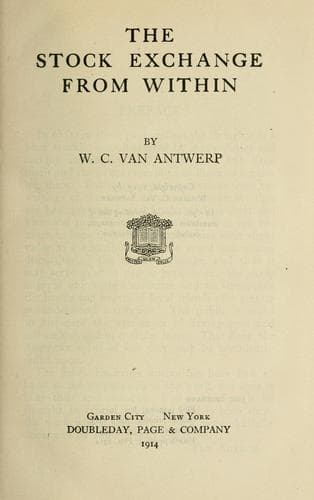
The Stock Exchange from WithinVan Antwerp, William C. (William Clarkson)
History
The Stock Exchange from Within
Van Antwerp, William C. (William Clarkson)
New York Stock Exchange; Stock exchanges
A word should be said about the methods of London stockbrokers in
carrying stocks for their customers, because this also is quite
different from the practice in New York. Here the strongest houses
rarely loan stocks, unless attracted by unusual rates of interest; in
London it is the common practice of even the best houses to carry-over,
or as we term it, loan, a great part of the commitments entered into
during the account. One reason for this is that in London customers buy
their stocks outright more frequently than is done here. Scalping small
profits is not practised on anything like the New York scale. Most of
the stocks dealt in do not pass from hand to hand like American stocks,
but must have a transfer form with the name and address of the buyer
and seller attached to the certificate. There is also a government
stamp-tax of ½ per cent. on the money involved, which tax must be paid
by the buyer when the stock is transferred to him. When the buyer sells
this stock he may not have immediate use for the proceeds, and so,
instead of delivering the stock standing in his name, he instructs his
broker to borrow it from account to account, thus receiving interest on
his money. The tax is a heavy one--figured in American money it amounts
to $50 per hundred shares at par--and the Englishman very naturally
resorts to methods such as these to recoup at least a part of it.
Again, from the stockbroker’s point of view, if he buys securities on
margin for a customer, he (the broker) must either carry them with the
jobber or with another broker, or he will have to pay the government
tax himself. Naturally he hastens to loan them, because, should the
client sell the securities in the course of the next account when
they would have to be delivered, the broker would lose the tax. He
avoids this loss by instructing a jobber to contango or carry-over the
securities until the following account day. On the other hand, if the
broker is certain that his client has purchased his securities for a
long pull on a margin basis, he will often pay for the stock himself,
transfer it to his own name, and willingly submit to the government
tax, knowing that he can recover the outlay from the handsome rate of
interest charged the client.
Another vital point of difference between the London and the New York
Stock Exchange lies in the nature and volume of the business done.
Americans are prone to think of their foremost Exchange as one which,
in the volume and extent of its transactions, compares favorably with
the great Bourses of the world; they like to think of New York as
the financial centre of the universe, and they paint rosy pictures
of America as a great creditor nation. But they err in each of these
ambitious dreams. The New York Stock Exchange, with all its magnitude,
cannot compare with its London prototype; New York is by no means the
financial centre of the world, and America is not a creditor, but a
debtor nation.
Public-domain text, read in full here on John Shaqi.
Reviews
Reviews
No reviews yet
Be the first to share your thoughts on this work.
Elsewhere in the archive
Join the Discussion
Join the discussion
Sign in to leave a comment or review.
Sign InorCreate an account