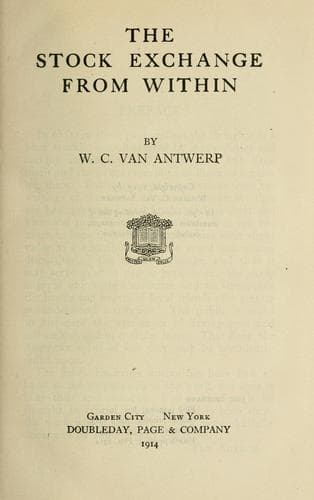
The Stock Exchange from WithinVan Antwerp, William C. (William Clarkson)
History
The Stock Exchange from Within
Van Antwerp, William C. (William Clarkson)
New York Stock Exchange; Stock exchanges
Every now and then some one who has not given much thought to the
matter asks the questions, “Of what real use is the Stock Exchange?”
“What does it accomplish?” “Is it a necessary and useful part of our
economic life, or is it merely a means of promoting speculation and
gambling?” These are fair questions, and they are asked in good faith.
To be sure they have been answered many times by writers on economic
subjects, but the trouble is that in our hurried American life we do
not read the economists, preferring to get our impressions from the
hasty utterances of some one who knows no more about it than we do.
The study of any form of economic development, like the study of
sciences and philosophies, requires infinite patience. But the “man
in the street” is bored to death by such methods; he wants to take a
short cut to his conclusions; merely tasting the Pierian spring he
hurries on to judgments that are superficial, haphazard, and often
crude and blundering. And yet at bottom this man, a good citizen with
an open mind, invariably wants the truth. He may be too busy to dig it
up himself, but he knows it when he sees it, and once he has grasped
it he has no patience with those who seek to turn him from it. To this
average man, who holds in his hands the balance of power in America, I
venture to say something about markets.
The first thing a man asks when he wishes to buy is “the price.” Every
minute of the day, all over the world, that question is on men’s lips.
As it is a necessary prelude to all forms of trade, it follows that
everything that enters into the making of prices becomes at once of
primary importance. The more scientific the price, and the nicer and
more accurate the making of it, the better the bargain for both buyer
and seller and for trade generally, bearing in mind the distinction
between prices, which are temporary and move rapidly--and values, which
are intrinsic and move slowly. The price of a thing is what you can
get for it; the value is its real worth to you, and hence it cannot be
defined or measured, since a thousand considerations may enter into
it, such as caprice, sentiment or association. If _real_ values could
be determined, they would necessarily be identical with prices, but as
they cannot be ascertained in ordinary commodities of trade, prices
become the really essential considerations and values the subordinate
ones. Let us see, then, how prices are made, for this is one of the
reasons why exchanges exist.
Public-domain text, read in full here on John Shaqi.
Reviews
Reviews
No reviews yet
Be the first to share your thoughts on this work.
Join the Discussion
Join the discussion
Sign in to leave a comment or review.
Sign InorCreate an account