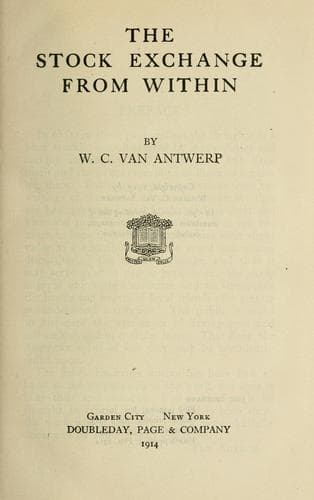
The Stock Exchange from WithinVan Antwerp, William C. (William Clarkson)
History
The Stock Exchange from Within
Van Antwerp, William C. (William Clarkson)
New York Stock Exchange; Stock exchanges
If you want to buy, let us say, a piano, you go to the dealer and ask
the price, and as he is the only person in the neighborhood who deals
in pianos, you must either accept his offer or look elsewhere. But
to look elsewhere takes time and labor; dealers in pianos are widely
separated; moreover, there is no open competition among them such as
you would like, and so finally when you have bought you feel perhaps
you have not secured your money’s worth. You would have secured a much
better bargain, no doubt, had there been twenty dealers in the room
competing with each other, and a still better bargain had their number
been fifty, or a hundred, or two hundred, because that would mean
competition, and the more competition there is, in close contact and
governed by rigid business rules, the more certain the approach to a
perfect price. Everywhere in the world fairs and other gatherings of
merchants are held at periodic intervals because people demand them
in their effort to secure proper prices by competitive bidding and
offering. One of the first travelers to penetrate the heart of Africa
found among the natives this phenomenon of trade, showing that it is
instinctive; indeed, it may be traced to the earliest known period
in the history of any people. If you arise before daybreak in London
and go to Billingsgate and Covent Garden, or in Paris to the _Halles
Centrales_--Zola’s “Ventre de Paris”--you will find there the modern
type of these markets in their utmost perfection.[1]
This is why Exchanges exist, not only Stock Exchanges, but
market-places of all kinds: Buyers seek the largest market they can get
in order to obtain the lowest prices; sellers, in order to obtain the
highest prices; and so it was learned long ago that economy of time and
labor, as well as a theoretically perfect market, could be best secured
by an organization under one roof of as many dealers in a commodity as
could be found.[2] Bear in mind that this result, moreover, is best
accomplished when the organization is so controlled by rigid rules of
business morality as to insure to every one who does business there,
great and small, rich and poor, an absolutely square deal. In such a
market every purchase is made with the most thorough acquaintance with
the conditions involved. Each dealer, each broker, each speculator,
strives to obtain the best knowledge of the supply and demand, and
the earliest news that may affect it, and each buyer or seller has an
equal and a fair opportunity to profit by the resultant effect on the
market of all these various agencies. The larger the body of brokers
and traders, then, the more accurate the standards of value thus
created. It is a pity you could not have bought your piano under such
conditions.[3]
Public-domain text, read in full here on John Shaqi.
Reviews
Reviews
No reviews yet
Be the first to share your thoughts on this work.
Join the Discussion
Join the discussion
Sign in to leave a comment or review.
Sign InorCreate an account