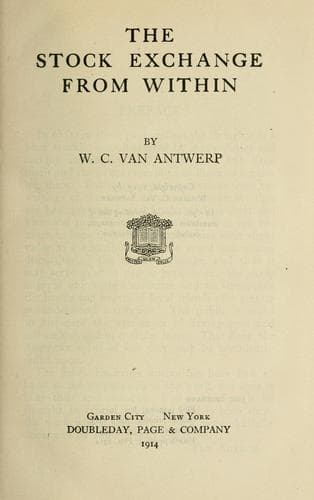
The Stock Exchange from WithinVan Antwerp, William C. (William Clarkson)
History
The Stock Exchange from Within
Van Antwerp, William C. (William Clarkson)
New York Stock Exchange; Stock exchanges
Some of the members of the Exchange dealing on the curb have apparently
been satisfied with the prevailing conditions, and in their own selfish
interests have maintained an attitude of indifference toward abuses.
We are informed that some of the most flagrant cases of discreditable
enterprises finding dealings on the curb were promoted by members of
the New York Stock Exchange.
REFORMATION OF THE CURB
The present apparent attitude of the Exchange toward the curb seems to
us clearly inconsistent with its moral obligations to the community
at large. Its governors have frequently avowed before this committee
a purpose to co-operate to the greatest extent for the remedy of any
evils found to exist in stock speculation. The curb market as at
present constituted affords ample opportunity for the exercise of such
helpfulness.
The Stock Exchange should compel the formulation and enforcement of
such rules as may seem proper for the regulation of business on the
curb, the conduct of those dealing thereon, and, particularly, for the
admission of securities to quotation.
If the curb brokers were notified that failure to comply with such
requirements would be followed by an application of the rule of
non-intercourse, there is little doubt that the orders of the Exchange
would be obeyed. The existing connection of the Exchange gives it ample
power to accomplish this, and we do not suggest anything implying a
more intimate connection.
Under such regulation, the curb market might be decently housed to the
relief of its members and the general public.
THE ABUSE OF ADVERTISING
A large part of the discredit in the public mind attaching to “Wall
Street” is due to frauds perpetrated on the small investor throughout
the country in the sale of worthless securities by means of alluring
circulars and advertisements in the newspapers. To the success of such
swindling enterprises a portion of the press contributes.
Papers which honestly try to distinguish between swindling
advertisements and others may not in every instance succeed in doing
so; but readiness to accept advertisements which are obviously traps
for the unwary is evidence of a moral delinquency which should draw out
the severest public condemnation.
So far as the press in the large cities is concerned the correction of
the evil lies, in some measure, in the hands of the reputable bankers
and brokers; who, by refusing their advertising patronage to newspapers
notoriously guilty in this respect, could compel them to mend their
ways, and at the same time prevent fraudulent schemes from deriving an
appearance of merit by association with reputable names.
Public-domain text, read in full here on John Shaqi.
Reviews
Reviews
No reviews yet
Be the first to share your thoughts on this work.
Elsewhere in the archive
Join the Discussion
Join the discussion
Sign in to leave a comment or review.
Sign InorCreate an account