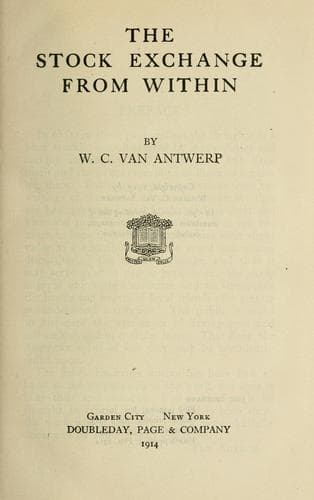
The Stock Exchange from WithinVan Antwerp, William C. (William Clarkson)
History
The Stock Exchange from Within
Van Antwerp, William C. (William Clarkson)
New York Stock Exchange; Stock exchanges
The broker who buys for a client to-day does not know, and sometimes
the client himself does not know, whether the securities are “bought to
keep,” or are to be sold to-morrow; similarly the broker has no means
of knowing whether the client, who deposited a ten-point margin at
the time of his purchase, will or will not deposit another ten points
to-morrow, and continue such payments until his securities are wholly
paid for. In the large majority of cases the intent of the speculative
buyer is to sell as soon as he can get a satisfactory profit, but
that does not make him a gambler by any means. Why? Because, if he
bets $1000 on a horse race, one party to the transaction wins and the
other loses; whereas, if he deposits $1000 as margin against a stock
speculation and makes a profit of say $500, the broker loses nothing
by paying him that profit when the account is closed. No property
changes hands in the one case, while, in the other, actual property is
purchased and held ready for delivery on demand. The law is clear in
classifying the operations of bucket-shops with gambling transactions,
because in a large majority of instances no actual purchase is made;
the “buyer” merely bets in that case as to what subsequent quotations
will be; the “trade” is between two principals, one of whom must lose
if the other wins.
The Hughes Commission, as I have said, went very fully into all
these matters. It was in session six months, and many witnesses were
examined. After considering all the pros and cons of margin trading,
the experience of England and Germany in dealing with speculation, the
three-years’ debate in Congress on the Hatch Anti-Option Bill, and
the voluminous reports of the Industrial Commission, the conclusion
was reached “to urge upon all brokers,” as shown in the paragraph
cited, a general agreement on margins of not less than 20 per cent.
It must be borne in mind that this was not in the nature of a formal
recommendation, but rather as the expression of a hope that some
measure of reform might be accomplished if such concerted action by
brokers were feasible.
Public-domain text, read in full here on John Shaqi.
Reviews
Reviews
No reviews yet
Be the first to share your thoughts on this work.
Join the Discussion
Join the discussion
Sign in to leave a comment or review.
Sign InorCreate an account