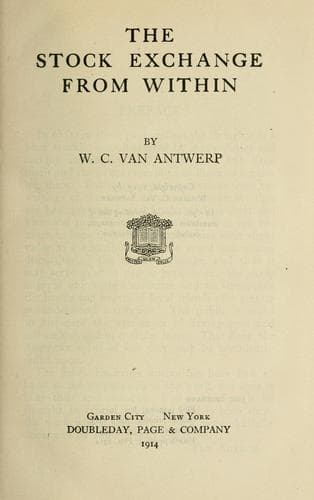
The Stock Exchange from WithinVan Antwerp, William C. (William Clarkson)
History
The Stock Exchange from Within
Van Antwerp, William C. (William Clarkson)
New York Stock Exchange; Stock exchanges
At the moment it is difficult to see how an inflexible rule of 20 per
cent. margins could be put in practice without seriously interfering
with really sound business. A telegraphic order may be received from a
customer of the utmost responsibility who may happen to be in Europe.
Any stockbroker, and any business man in mercantile trade, would be
glad to execute for such a person all the orders he chose to entrust,
regardless of margins. In such a case no question of motive enters into
the transaction; it may ultimately prove to be a speculation pure and
simple, or the buyer may cable instructions to deliver the securities
to his bank, in which case it would seem to be an investment; but,
regardless of that, an insistence by the broker on a 20 per cent.
margin would be silly, and would merely drive the business elsewhere or
prevent it altogether.
Numerous instances of a similar sort might be cited to show how
difficult it would be to enforce margin prohibitions in all these
perfectly legal contracts. Germany tried it in the law of 1896, with
disastrous consequences, which I have described elsewhere. It is a
matter that will always be a fruitful topic of discussion, yet it
differs in no essential respect from the practice of a speculator in
real estate who pays down a small percentage of a purchase price and
borrows the balance on mortgage. It is similar to what the merchant
does when he fills his shelves with goods bought with a fractional
payment in cash and the balance at some future date. In all these cases
involving property let me repeat that the deposit of a specified sum
by the principal and an agreement or contract with the broker is a
perfectly valid transaction.[24]
That newspaper criticism and attacks by social mentors should go to
extreme lengths in deprecating stock speculation by crude, greedy,
and unsophisticated people is perhaps, after all, a perfectly useful
function, and if such critics err in going to great extremes, that too
may be set down as right and proper, for it is perhaps better to go
too far than not to go far enough. The interests of the Stock Exchange
are the interests of the whole country; its welfare depends upon an
intelligent and thrifty people; its aims are public-spirited and
patriotic. Whatever it may lose in the way of business from ignorant
and silly people who are driven out of blind speculative undertakings
leading to losses which they can ill afford, it will gain tenfold
in imparting sound information through candor and publicity. On the
other hand, unless we are prepared to abolish property altogether,
do away with the instruments of credit, and suppress all forms of
trading designed to supply our future requirements, we may as well
reconcile ourselves to the inevitable and take what comfort we may
in the reflection that prudence, thrift, and foresight are not to be
eliminated, merely because the proletariat below stairs sometimes
indulges in speculation and suffers the consequences of its folly.
Public-domain text, read in full here on John Shaqi.
Reviews
Reviews
No reviews yet
Be the first to share your thoughts on this work.
Join the Discussion
Join the discussion
Sign in to leave a comment or review.
Sign InorCreate an account