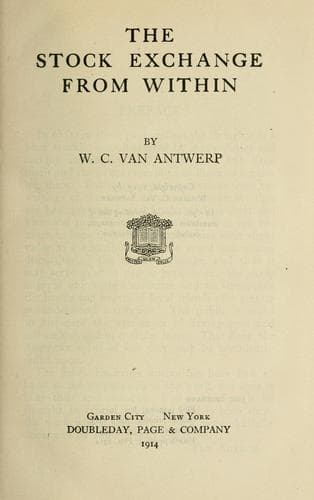
The Stock Exchange from WithinVan Antwerp, William C. (William Clarkson)
History
The Stock Exchange from Within
Van Antwerp, William C. (William Clarkson)
New York Stock Exchange; Stock exchanges
Accidents like diplomatic entanglements, rumors of war, earthquakes,
and drought are constantly occurring to upset the plans of bulls and
bring fat profits to bears in a hurry, while matters that bring about
higher markets are generally things long anticipated, in which the
profits that accrue to the bulls come about slowly and laboriously,
and always with the attendant risk that a disturbance in any corner of
the globe may bring on a sudden smash that will undo the upbuilding of
months. In theory, therefore, there should be at least as many bears
as bulls in all active markets, but in practice the large majority are
always bulls, to whose sanguine and credulous natures the bear is a
thing apart--a gloomy and misanthropic person hovering about like a
vulture awaiting the carrion of a misfortune in the hope of a profit.
Naturally the layman cannot understand him, and would like to suppress
him.
Despite the fact that the odds seem to favor the bears, there is an
old and true saying that no Ursa Major ever retired with a fortune.
Wall Street has seen many of them, and with perhaps one exception the
records agree that the chronic pessimists have not succeeded. Fortune
seems to have smiled on them at intervals; in the country’s early days
of construction and development mistakes were made that brought about
disaster, but in the long run such tremendous progress has resulted
in America as to defeat the aspirations of any man or group of men
who stood in its way. The big bears, as a rule, have “over-stayed
the market.” Imbued with the hope that worse things were in store,
they have been swept away by the forces they sought to oppose. One of
them, a power in his day, was so obsessed with the notion that all
prices were inflated, that he has been known to sell stocks short
“for investment.” One night when a lady at his side remarked on the
beauty of the moon, he is said to have replied with that absent-minded
mechanical skepticim inherent in the bear, “yes, but it’s too high; it
must come down.”
One would think the ideal temperament for a speculator would be
absolute impartiality, with an open mind uninfluenced by sentiment,
ever ready to take advantage of all fluctuations as they occur. The
ups and downs of a stock market always show, on average long periods,
a practically equivalent swing each way, so it would seem that the
speculator most likely to profit by these fluctuations would be one
without preconceived prejudices, ready at all times to turn bull or
bear as the occasion required. As a matter of fact, this type is the
rarest of all, being confined, generally speaking, to the professional
“traders” on the large exchanges, necessarily a very small minority
of the speculative group, yet withal perhaps the most uniformly
successful. These men, it must be understood, are not speculators, but
traders, a nice distinction involving “catching a turn,” as opposed to
the speculative habit of “taking a position.”
Public-domain text, read in full here on John Shaqi.
Reviews
Reviews
No reviews yet
Be the first to share your thoughts on this work.
Join the Discussion
Join the discussion
Sign in to leave a comment or review.
Sign InorCreate an account