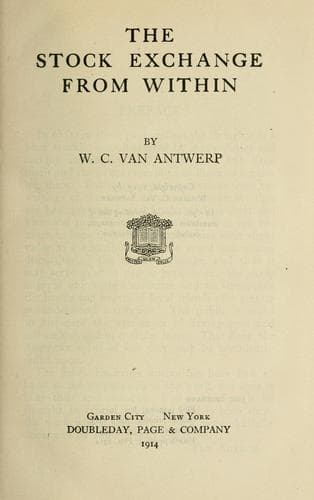
The Stock Exchange from WithinVan Antwerp, William C. (William Clarkson)
History
The Stock Exchange from Within
Van Antwerp, William C. (William Clarkson)
New York Stock Exchange; Stock exchanges
In active times I have known one of them to operate simultaneously
in the New York Stock market, in the cotton market, and in the wheat
market, trading at the same time in London and Paris, “shifting his
position,” or “switching” from the bull to the bear side twice in a
single day, and closing all his trades at three o’clock with a total
net profit of less than a thousand dollars on a turnover of 30,000
shares, to say nothing of the transactions in cotton and grain. It
goes without saying that to do all these things in one day requires
a curiously mercurial temperament, and calls for nerve and celerity
altogether foreign to the average speculator. Such a man, moreover,
contributes but little to the making of prices and values, which is the
function of large markets; his chief economic usefulness lies rather in
the enormous revenues he pays to the State. The man whose operations I
have just described contributed in a single year $75,000 to the State
Government in stock-transfer taxes.
The scientific way to measure the value of speculators in wide markets
is to consider the bull as one whose purchases in times of falling
prices serve to minimize the decline, and the bear as one who serves a
doubly useful purpose in minimizing the advance by his short sales and
in checking the decline by covering those sales. All these operations
serve useful economic purposes, since the more buyers and sellers there
are, the greater the stability of prices and the nearer the approach of
prices to values.
This, as I have said, is the scientific way to look at it, and the
correct way, but the popular way is something quite different. From
this point of view the man who sells property he does not immediately
possess is thought to be a menace, who depresses prices artificially
and works a disadvantage to the investor or, in the produce markets,
to the producer. Nothing could be more fallacious than this, because
of the fact that just as every routine sale of actual stock requires
a buyer, so every short sale by a bear requires a purchase by him of
equal magnitude. And it is precisely these repurchasing or “covering”
operations of the bears that do the utmost good in the way of checking
declines in times of panic or distress.
Public-domain text, read in full here on John Shaqi.
Reviews
Reviews
No reviews yet
Be the first to share your thoughts on this work.
Join the Discussion
Join the discussion
Sign in to leave a comment or review.
Sign InorCreate an account