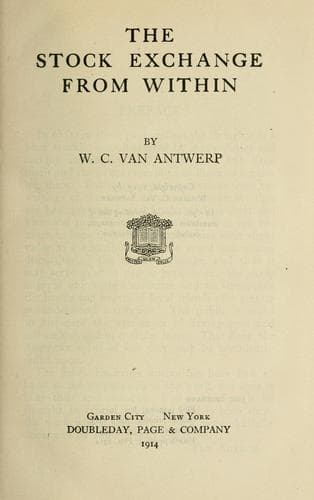
The Stock Exchange from WithinVan Antwerp, William C. (William Clarkson)
History
The Stock Exchange from Within
Van Antwerp, William C. (William Clarkson)
New York Stock Exchange; Stock exchanges
“In reply also to the prevalent opinion that ‘short selling’ unduly
depresses security values, it should be stated that ‘short sellers’ are
frequently the most powerful support which the market possesses. It is
an ordinary affair to read in the press that the market is sustained
or ‘put up’ at the expense of the ‘shorts’ who, having contracted
to deliver at a certain price can frequently easily be driven to
‘cover.’ Short selling is thus a beneficial factor in steadying prices
and obviating extreme fluctuations. Largely through its action, the
discounting of serious depressions does not take the form of a sudden
shock or convulsion, but instead is spread out over a period of time,
giving the actual holder of securities ample time to observe the
situation and limit his loss before ruin results. In fact, there could
be no organized market for securities worthy of the name, if there did
not exist two sides, the ‘bull’ and the ‘bear.’ The constant contest
between their judgments is sure to give a much saner and truer level of
prices than could otherwise exist. ‘No other means,’ reports the Hughes
Committee, ‘of restraining unwarranted marking up and down of prices
has been suggested to us.’”[31]
So much for the functions of the bear in markets that deal in invested
capital. In the commodity markets he becomes of even greater value,
indeed, he is well-nigh indispensable. Mr. Horace White, who was the
Chairman of the Hughes Investigating Committee, cites this instance:
“A manufacturer of cotton goods, in order to keep his mill running all
the year round, must make contracts ahead for his material, before
the crop of any particular year is picked. The cotton must be of a
particular grade. He wishes to be insured against fluctuations in both
price and quality; for such insurance he can afford to pay. In fact he
cannot afford to be without it. There are also men in the cotton trade,
of large capital and experience, who keep themselves informed of all
the facts touching the crops and the demand and supply of cotton in the
world, and who find their profit in making contracts for its future
delivery. They do not possess the article when they sell it. To them
the contract is a matter of speculation and short selling, but it is a
perfectly legitimate transaction.
Public-domain text, read in full here on John Shaqi.
Reviews
Reviews
No reviews yet
Be the first to share your thoughts on this work.
Join the Discussion
Join the discussion
Sign in to leave a comment or review.
Sign InorCreate an account