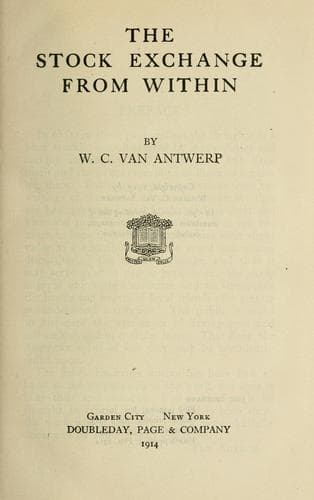
The Stock Exchange from WithinVan Antwerp, William C. (William Clarkson)
History
The Stock Exchange from Within
Van Antwerp, William C. (William Clarkson)
New York Stock Exchange; Stock exchanges
“The prices of all industrial securities have fallen,” said the
Deutsche Bank in 1900, “and this decline has been felt all the
more because by reason of the ill-conceived Bourse Law, it struck
the public with full force without being softened through covering
purchases”--i. e., by the bears. Again, four years later, when the law
was still in force, the same authority states “a serious political
surprise would cause the worst panic, because there are no longer any
dealers (shorts) to take up the securities which at such times are
thrown on the market.” The Dresdner Bank in 1899 reported that the
dangers arising from this prohibition cannot be overestimated “if with
a change of economic conditions the unavoidable selling force cannot be
met by dealers willing and able to buy.”
“Short sellers do not determine prices,” says Professor Huebner. “By
selling they simply express judgment as to what prices will be in the
future. If their judgment is wrong they will suffer the penalty of
being obliged to go into the market and buy the securities at higher
prices. Nine tenths of the people are by nature ‘bulls,’ and the higher
prices go, the more optimistic and elated they become. If it were not
for a group of ‘short sellers,’ who resist an excessive inflation, it
would be much easier than now to raise prices through the roof; and
then, when the inflation became apparent to all, the descent would
be abrupt and likely unchecked until the basement was reached. The
operations of the ‘bear,’ however, make excessive inflation extremely
expensive, and similarly tend to prevent a violent smash because the
‘bear,’ to realize his profits, must become a buyer. The writer has
been told by several members of the New York Stock Exchange that they
have seen days of panic when practically the only buyers, who were
taking the vast volume of securities dumped on the exchange, were those
who had sold ‘short,’ and who now turned buyers as the only way of
closing their transactions. They were curious to know what would have
happened in those panic days, when everybody wished to sell and few
cared to invest, if the buying power had depended solely upon the real
investment demand of the outside public.
Public-domain text, read in full here on John Shaqi.
Reviews
Reviews
No reviews yet
Be the first to share your thoughts on this work.
Join the Discussion
Join the discussion
Sign in to leave a comment or review.
Sign InorCreate an account