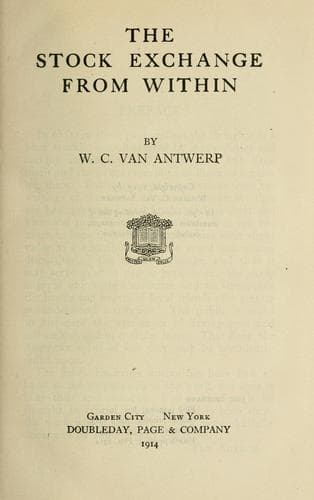
The Stock Exchange from WithinVan Antwerp, William C. (William Clarkson)
History
The Stock Exchange from Within
Van Antwerp, William C. (William Clarkson)
New York Stock Exchange; Stock exchanges
Demagogues have set the agricultural classes against Wall Street and
against Exchanges, but producers everywhere, in default of exchanges,
are forming quasi-exchanges of their own. Every day we hear of
combinations, Farmers’ Alliances, rural co-operative movements, etc.,
each designed to regulate the market for eggs, butter, potatoes, and
such things, and each having for its purpose the very functions which
govern a Stock Exchange in its own field--namely, the establishment of
a fair price under the nearest possible approach to ideal conditions.
It is now proposed in Congress that the Department of Agriculture
shall collect and transmit to the agricultural districts by telephone
and telegraph all available information concerning price movements,
markets, and centres of supply and demand, this again embodying the
essential functions performed in its own field by a great exchange.
In practice, of course, there can be no exchange to deal in perishable
products of the farm, and this is a pity, because if such an exchange
were practicable we should hear less of our old friend the cost of
living. Why? Because at present the market for these commodities is
controlled by commission dealers and by middlemen. The producer and the
consumer are alike at the mercy of these people; the price is fixed by
them; the number of bona fide dealers actually bidding against each
other is limited, in many instances there is no competition whatever;
the producer and the commission dealer are, moreover, widely separated;
the man who sells has few sources of information, and it is the
business of the dealer who buys to see that he gets none; the small
producer therefore has to submit to a great inequality in price, and
often to downright cheating. There is no standard. There are no rules
governing the dealer, and no high-minded board to enforce his honesty.
Naturally this sort of thing contributes to the cost of living, since
the commission dealer, on his part, regulates his profits just in
proportion to the ignorance, cupidity or remoteness of the farmer,
while the middlemen, of whom there are sometimes three or four, apply
the same iniquitous processes to the ultimate purchaser--who happens
to be you or me. Every thinking man knows that this is rank economic
error.[4]
Public-domain text, read in full here on John Shaqi.
Reviews
Reviews
No reviews yet
Be the first to share your thoughts on this work.
Join the Discussion
Join the discussion
Sign in to leave a comment or review.
Sign InorCreate an account