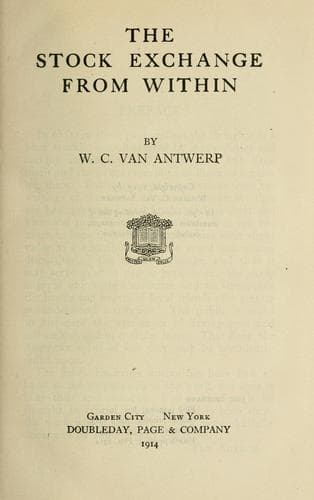
The Stock Exchange from WithinVan Antwerp, William C. (William Clarkson)
History
The Stock Exchange from Within
Van Antwerp, William C. (William Clarkson)
New York Stock Exchange; Stock exchanges
If this book were written for people instructed in economic matters
there would be no occasion to dilate upon the usefulness of bears and
the value of short selling, but since we are addressing laymen who do
not understand how the bear can be a useful factor, we may venture to
say once more that insurance is the chief advantage in his operations.
Ex-Governor White’s contribution to the subject, which I have quoted
in this chapter, is strongly supported by Mr. Conant, who shows
that valuable progress in opening new countries and developing new
industries is often made possible by “bearish” operations designed to
“hedge” or insure the new undertaking against loss.
“The broker who has a new security which he desires to place from time
to time in the future, making possible, for instance, the opening of a
new country to railway traffic, protects himself against loss resulting
from future changes in market conditions by selling other securities
for future delivery at current prices. These securities will realize
a profit when the date arrives for delivery if the market has in the
meantime become unfavorable, and will offset the loss upon his new
securities. They will have to be bought at a loss if the movement of
prices has been upward, but the upward movement will afford a profit
upon the new securities which he is seeking to place upon the market.
Thus, to quote Georges-Levy, ‘there is a genuine insurance, which the
broker will have himself organized and on which he will willingly pay
the premium for protection against any accident.’”[38]
An instance such as this serves to show the difference between gambling
and speculating, terms that are often misapplied by critics of stock
markets. A gambler seeks and makes risks which it is not necessary
to assume, and which, in their assumption, contribute nothing to the
general uplift. But the speculator--in the instance just cited, a bear
who sells short--volunteers to assume those risks of business which
must inevitably fall somewhere, and without which the mine, or the
factory, or the railroad could not be undertaken. His profession, and
the daily risks he assumes, call for special knowledge and superior
foresight, so that the probability of loss is less than it would be to
others. If he did not do it--if there were no bear speculators--the
same risks would have to be borne by others less fitted to assume them
or the useful projects in question would not be undertaken at all.
Public-domain text, read in full here on John Shaqi.
Reviews
Reviews
No reviews yet
Be the first to share your thoughts on this work.
Join the Discussion
Join the discussion
Sign in to leave a comment or review.
Sign InorCreate an account