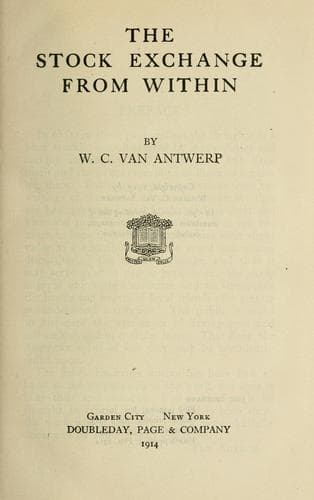
The Stock Exchange from WithinVan Antwerp, William C. (William Clarkson)
History
The Stock Exchange from Within
Van Antwerp, William C. (William Clarkson)
New York Stock Exchange; Stock exchanges
So general is the employment of these hedging or insurance operations
that in the case of cotton--to cite but one instance--the business is
regarded by practically all cotton merchants as an absolute necessity
under modern methods of conducting business. “An idea of the value
of the hedging function may be obtained,” says Herbert Knox Smith,
Commissioner of Corporations, “when it is stated that in Great Britain
banks very generally refuse to loan money on cotton that is not
hedged. Moreover, it is almost universally conceded that, since the
introduction of hedging, failures in the cotton trade, which had
previously been frequent, have been materially reduced as a direct
result of the greater stability with which transactions in spot cotton
can be conducted.”[39]
In conclusion it may be noted that as early as 1732 an attempt was made
in England to prevent short sales by law, that the law was recognized
a mistake and subsequently repealed. To-day there is no law on the
English Statute books restricting speculation in any form. In America
the New York State Legislature enacted a law in 1812 and the Federal
Government in 1864, both designed to prevent short selling. These laws
have also been repealed and they will not be revived. The bear has
come to stay. As a spectre to frighten amateurs, he may continue for a
time to stalk abroad o’ nights; as a necessary and useful part of all
business he is a substantial reality. And he is not “immoral.”[40]
CHAPTER IV
THE RELATIONSHIP BETWEEN THE BANKS AND THE STOCK EXCHANGE
“A million in the hands of a single banker is a great power,” said
Walter Bagehot; “he can at once lend it where he will, and borrowers
can come to him because they know or believe that he has it. But the
same sum scattered in tens and fifties through a whole nation is no
power at all; no one knows where to find it or whom to ask for it.”
This explains the power of Wall Street. Money flows there for the same
reason that water flows downhill. The great agricultural districts
of the West, for example, will gather from their crops this year
several hundred millions of dollars. They have no real economic use
for all this money in the farming districts; the large commercial and
industrial undertakings that help to make America rich and powerful are
not in that neighborhood.
Public-domain text, read in full here on John Shaqi.
Reviews
Reviews
No reviews yet
Be the first to share your thoughts on this work.
Join the Discussion
Join the discussion
Sign in to leave a comment or review.
Sign InorCreate an account