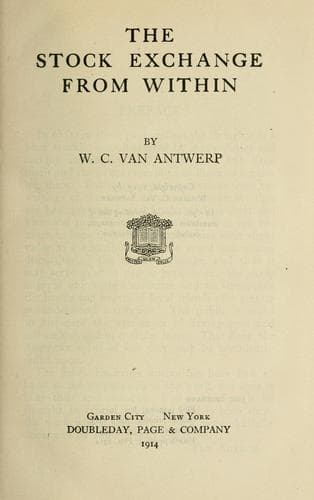
The Stock Exchange from WithinVan Antwerp, William C. (William Clarkson)
History
The Stock Exchange from Within
Van Antwerp, William C. (William Clarkson)
New York Stock Exchange; Stock exchanges
Particular trades settle in particular districts, and the money they
require must be sent to them from other districts. “Commerce is
curiously conservative in its homes;” the steel trade concentrates in
and around Pittsburg, the grain trade at Chicago, wholesale merchants
in special lines are always to be found huddled together in our big
cities in neighborly intimacy; and once a trade has settled in one spot
it remains there. The millions that go West to pay the farmer must
therefore go elsewhere to pay others as fast as a demand for money
arises, because the price that will be paid for it elsewhere is greater
than the price it will bring in the farmer’s pockets. This is doubly
true because, as we have said, there are no imperious demands for money
for commercial undertakings in the farmer’s neighborhood, and, even if
there were, home enterprises are seldom attractive; curiously enough
there is a familiarity about them and their local promoters that breeds
contempt. Besides, these millions are scattered in small sums all over
the agricultural States; there is no cohesion, no concentration.
What then becomes of these vast sums? They are deposited in the local
banks, and the local bankers, who are wisely permitted by law to
deposit three fifths of their legal reserves in a city bank, promptly
transfer the funds that are not required at home to the bank that will
pay interest on them. In this way large capital accumulates, and when
we say this is a wise provision of the law we mean that scattered
reserves in local country banks are of no more avail in emergencies
than the five-dollar bills in the people’s pockets; but, gathered
into one great central fund that will aggregate a sum large enough to
provide every solvent bank and business house with ample support in
times of distress, they accomplish a purpose worth talking about.
This is the way they do in Europe, but say “Central Bank” in America,
and people are frightened out of their wits. They say politics would
dominate it; “the interests” would control it. The bigness of things
seems to paralyze them. But to attack a thing merely because it is big
and powerful is no argument. In a country full of big things it does
not ring true; it is un-American, and, as for the bogy of a centralized
banking control, there is infinitely more of it in New York to-day,
under the existing system, than there could possibly be under the plan
proposed by the original Aldrich measure. However, the idea of a great
Central Bank is not the subject under discussion.
Public-domain text, read in full here on John Shaqi.
Reviews
Reviews
No reviews yet
Be the first to share your thoughts on this work.
Join the Discussion
Join the discussion
Sign in to leave a comment or review.
Sign InorCreate an account