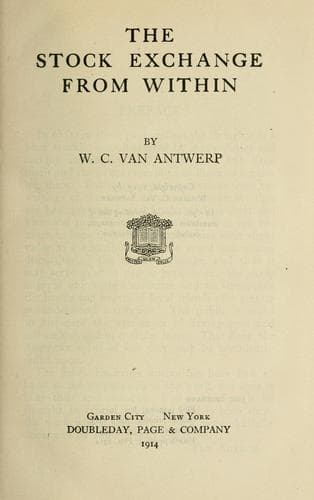
The Stock Exchange from WithinVan Antwerp, William C. (William Clarkson)
History
The Stock Exchange from Within
Van Antwerp, William C. (William Clarkson)
New York Stock Exchange; Stock exchanges
The Stock Exchange Clearing House is managed by a committee of five
members of the Board of Governors of the Exchange. Each day the seller
of stocks sends to the office of the buyer his “deliver” ticket, and
the buyer sends to the seller his “receive” ticket, this transaction
constituting a “comparison” by both parties, and an evidence that the
transaction has been entered on their books. Before 7 P.M. of that day
these tickets, and the sheet comprising the record, are sent to the
Clearing House. This sheet contains a “receive” and “deliver” column,
with all the transactions in each security grouped together, and with a
balance--i. e., a debit or credit, struck at the bottom. If there is a
credit, a draft on the Clearing House bank is attached; if a debit, a
check for the balance accompanies the sheet.
When the Clearing House receives this sheet a simple and a very
ingenious process ensues which relieves the broker of a great deal
of trouble, risk, and labor. If he has bought and sold, let us say,
an equal amount of stock, comprising numerous transactions, instead
of having to draw checks for all these separate trades, the Clearing
House settles the whole day’s transactions by a single check for the
actual balance. If his numerous purchases and sales do not balance,
and if there are various lots of stock to receive and deliver, the
Clearing House eliminates a host of intermediaries and puts him into
direct touch with one firm to whom he delivers, and with one from
whom he receives. He may have had no transaction with the firms thus
arbitrarily assigned to him; that makes no difference. The books of
the Clearing House always balance; somewhere a firm is entitled to a
receipt of stock, and somewhere another firm will be found to deliver
it to him.
Nothing could be simpler and more economical than the manner in which
the two are brought together. In such a system, the number of shares
actually delivered is reduced by the Clearing House to one third of
the number represented by the broker’s actual transactions, while the
amount of money which he must command to meet his daily engagements
represents, on an average, only 25 per cent. of the actual capital
that would be required were it not for the excellent system thus
afforded him. Persons who wonder at the magnitude of Stock Exchange
transactions, and who jump to hasty conclusions as to the actual
capital involved, may well reflect upon the manner in which this method
reduces to a minimum the stockbroker’s drafts upon the banks.
Public-domain text, read in full here on John Shaqi.
Reviews
Reviews
No reviews yet
Be the first to share your thoughts on this work.
Join the Discussion
Join the discussion
Sign in to leave a comment or review.
Sign InorCreate an account