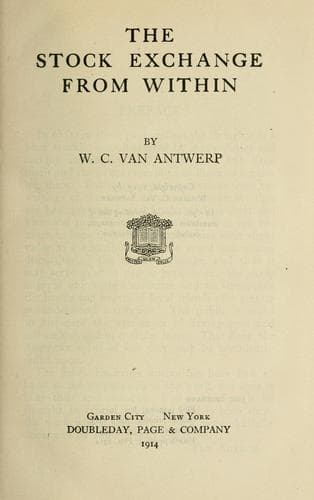
The Stock Exchange from WithinVan Antwerp, William C. (William Clarkson)
History
The Stock Exchange from Within
Van Antwerp, William C. (William Clarkson)
New York Stock Exchange; Stock exchanges
In June, July, and August, for example, conditions may warrant a hope
of bountiful harvests, while general business is dull and idle money
abundant. Such a prospect is always discounted, other things being
equal, by a rise in securities, and money that is not yet required
to market the crops thus finds employment as loans on Stock Exchange
collateral. Later on, when reviving business leads the interior banks
to call their New York balances, the depository banks meet the demand
by calling loans and by advancing rates. The speculative movement on
’Change is then checked or reversed just in proportion to the demand
for money elsewhere. It may continue for a while if the discounting
process has not been complete, or if there remains a wide disparity
between interest rates for money and net returns on securities; or if
the independent resources of the city banks are large enough to furnish
comfortable interest rates even after the westward drain has commenced,
but, generally speaking, “the move is over,” to quote the vernacular,
by the time business men want their money. Nine times out of ten any
monetary strain that results thereafter is not due to speculative
operations in securities nor to any other cause attributable to the
Stock Exchange.
A word should be said here concerning the Stock Exchange Clearing
House, because just as the Clearing House of the associated banks
ascertains and pays the balances of its members with a minimum outlay
of coin and legal tender notes and with great economy of time and
labor, so the Stock Exchange Clearing House stands the strain of an
enormous business, reduces the volume of checks and deliveries, and
relieves both the banks and the stockbrokers of an amount of risk and
confusion that would be well-nigh intolerable.
In order that the layman, for whom these pages are written, may
understand what this means, it may be said that if 500,000 shares of
stock are sold in a day on the Stock Exchange, and if we assume the
average price of these stocks to be 50, the checks paid out on that
day would be $25,000,000, and in a year at that rate certifications
would be necessary involving the stupendous total of $7,500,000,000.
This clumsy if not impossible method the Clearing House was designed
to avoid. Moreover, the actual daily transfer of such a volume of
securities is largely obviated by the Clearing House system, and thus
another and highly important economy is effected.
Public-domain text, read in full here on John Shaqi.
Reviews
Reviews
No reviews yet
Be the first to share your thoughts on this work.
Join the Discussion
Join the discussion
Sign in to leave a comment or review.
Sign InorCreate an account