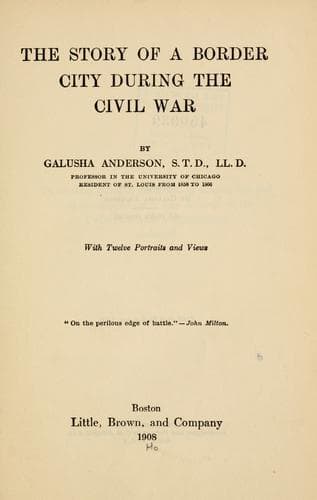
The story of a border city during the Civil WarAnderson, Galusha
History
The story of a border city during the Civil War
Anderson, Galusha
Missouri -- History -- Civil War, 1861-1865; Saint Louis (Mo.) -- History -- Civil War, 1861-1865
He at last asked his wife to play the piano, while the young daughters
danced. I noticed Mammy in an adjoining room, looking in upon the happy
scene and in her delight showing her ivory. About ten o’clock, with many
warm wishes each for the prosperity of the other, we parted, I to think
of the beneficence and beauty of slavery, and my host probably to
contemplate his success in commending to my good graces an institution
that I had been educated to abhor.
But what was the sequel of that evening’s conversation? What light did
the immediate future throw back upon it? Was my genial host’s emphatic
and repeated declaration that nothing could entice Wash and Mammy from
their home verified? The war came on apace. Everything appeared to be
out of joint. The most stable relations of life were unexpectedly and
strangely upset. Property in slaves grew precarious. And the first slave
in St. Louis reported in the papers as having run away was Wash.
His master was an officer of a bank. The young men employed there, to
whom he had declared as he did to me that nothing could induce Wash to
leave him, asked him if he intended to catch his runaway slave and bring
him back. He replied, “No, let him go, I never liked to have him around
anyway; I am glad that he has gone.” While this quite flatly
contradicted his previous utterances, under the circumstances it was
wisest not to attempt to apprehend his fleeing chattel. But for many
weeks, almost every day, some one in the bank would exasperatingly ask
him, “How is Wash?” But did Mammy, so full of affection and so delighted
with her home, prove true to her master and mistress? About two weeks
after Wash’s departure, she left without giving notice to the family.
She slept in the second story of the house. In the night she made up a
budget for herself, and threw it out into the yard. She then made a rope
of her bed-clothes, fastened one end of it to her bedstead, and threw
the other out of the window. Her improvised rope reached nearly to the
ground. She climbed down the rope, took up her budget and departed. That
household never saw that devoted mammy again. Such incidents are
representative of hundreds of others at that time. To be sure many of
the slaves were true to their masters and remained with their families
to the close of the war; but those who wished to leave did so, and the
fugitive slave law, having suddenly become a dead letter, could no
longer be invoked to catch them.
Public-domain text, read in full here on John Shaqi.
Reviews
Reviews
No reviews yet
Be the first to share your thoughts on this work.
Elsewhere in the archive
Join the Discussion
Join the discussion
Sign in to leave a comment or review.
Sign InorCreate an account