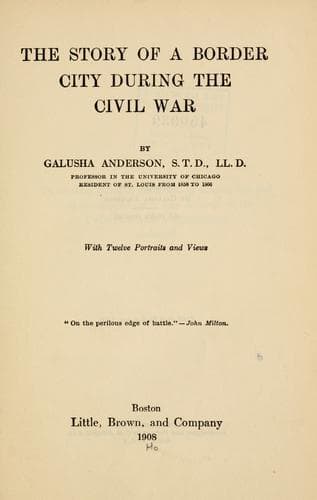
The story of a border city during the Civil WarAnderson, Galusha
History
The story of a border city during the Civil War
Anderson, Galusha
Missouri -- History -- Civil War, 1861-1865; Saint Louis (Mo.) -- History -- Civil War, 1861-1865
And the slaves had a pretty clear idea of the meaning of the war. They
knew that their own bondage was the real bone of contention. They
believed that their chains were to be broken and that they would soon be
free. Very early in the war the slaves saw the drift of events. As they
met each other they gave joyful expression to their expectation of
freedom, believing it to be near at hand. The morning after Camp Jackson
was taken, all the equipage of the camp was carried in army wagons down
the street near my door. Out of curiosity a promiscuous crowd had
gathered at the corner of the street to see the sight. Two female slaves
belonging to a family near by stood there grinning with delight. A young
woman, a pronounced secessionist, from one of the Gulf States, said,
with an air of triumph, stretching out her arm and excitedly shaking her
hand, “We’ll whip you yet.” In response, quick as a flash, the two slave
girls, pointing to the loaded wagons, gleefully cried out, “They’ve got
all your tents.” I knew those slaves, but had not known that they had
any interest in the war. However, it was now clear that they understood
its real meaning and took sides with the Unionists.
But slave-pens were a necessary adjunct of slavery. Even though, by
barbarous laws, men, women and children were made chattels, they still
continued to feel, think and will. And since many of them abhorred their
condition, it was necessary to pen them up so that they might be
securely kept and safely handled. Without thick stone walls, windows
barred with iron, strong doors locked and bolted, such property while
being bought and sold might vanish.
When in my pulpit, facing my congregation, I also faced, only half a
square away, a hideous slave-pen. It was kept by Mr. Lynch, an ominous
name. I sometimes saw men and women, handcuffed and chained together, in
a long two-by-two column, driven in there under the crack of the
driver’s whip, as though they were so many colts or calves. Had they
committed any crime? Oh, no, they had been bought, in different parts of
the State, by speculators, as one would buy up beef-cattle, and were
kept in the pen to be sold to the good people of St. Louis and of the
surrounding towns and country districts; and those not thus disposed of
were bought by slave-dealers for the New Orleans market.
Public-domain text, read in full here on John Shaqi.
Reviews
Reviews
No reviews yet
Be the first to share your thoughts on this work.
Elsewhere in the archive
Join the Discussion
Join the discussion
Sign in to leave a comment or review.
Sign InorCreate an account