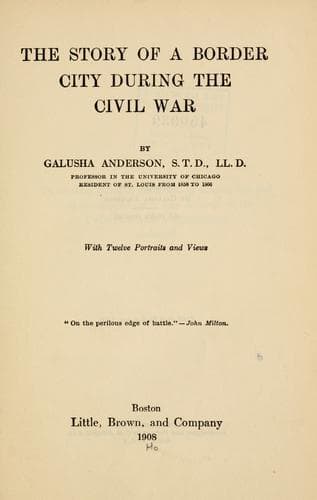
The story of a border city during the Civil WarAnderson, Galusha
History
The story of a border city during the Civil War
Anderson, Galusha
Missouri -- History -- Civil War, 1861-1865; Saint Louis (Mo.) -- History -- Civil War, 1861-1865
In 1859, some preachers from the eastern States, who had been at New
Orleans, attending the annual meeting of the Young Men’s Christian
Association of the United States, on their return to their homes,
stopped for three or four days in our city. They painted in glowing
terms the lavish and delicate hospitality that they had received in the
commercial capital of Louisiana. Appreciating the truth of all they
said, I nevertheless asked them if they visited the famous slave market
of that city. They said that they did not. I affirmed that they had
missed a great opportunity of seeing the other side of the picture; that
when they had seen and experienced the Christian hospitality of that old
Spanish and French city, they ought also to have viewed in contrast a
slave auction there—as heartless and cruel a scene as the wide earth
afforded. Regretting that they had so superficially done New Orleans,
they said, “Have you any slave markets here?” I replied, “We have some
slave-pens, but they are as paradise to perdition to the slave market
down there. Nevertheless, to-morrow I will show you the sights,
slave-pens included.”
In the morning, three or four of the residents of the city joined us, so
that we had a party of nine. We first visited the Mercantile Library
with its treasures of art. “Now,” I said, “since we are always impressed
by contrasts, let us go from tasteful rooms, books and art to Lynch’s
slave-pen.” All were agreed, and we were soon on our way. I had some
slight acquaintance with Mr. Lynch, having often spoken to him as he sat
out on the sidewalk in warm weather before his pen. He was sitting there
when we arrived. “Good morning, Mr. Lynch,” I said, “these gentlemen
wish to go into your slave-pen.” “Certainly,” he said, “gentlemen, I am
glad to see you.” He evidently thought that we had come to trade with
him. As we entered the room immediately in front of the pen, one of the
party, a tall ungainly-looking lawyer, full of humor and fun, said, “Mr.
Lynch, look out for these fellows, they are a pack of abolitionists.”
Lynch received the declaration simply as a chaffing joke and laughed
heartily. It was, however, sober truth. He put his great iron key into
the lock, turned back the bolt, swung open the door, and turning his
face towards us, said, “Gentlemen, I have not much stock on hand
to-day.” Every man in our company was shocked beyond expression by that
brutal announcement. We filed solemnly in. He shut the door and left us
alone and undisturbed to examine his “stock.” The room was in shape a
parallelogram. It was plastered and had one small window high up near
the ceiling. There was no floor but the bare earth. Three backless,
wooden benches stood next to the walls. There were seven slaves there,
both men and women, herded together, without any arrangement for
privacy. Some of the slaves were trying to while away their time by
playing at marbles. One fairly good-looking woman about forty years old,
Public-domain text, read in full here on John Shaqi.
Reviews
Reviews
No reviews yet
Be the first to share your thoughts on this work.
Elsewhere in the archive
Join the Discussion
Join the discussion
Sign in to leave a comment or review.
Sign InorCreate an account